

After 10+ years working across digital products, customer engagement, business operations, and automation, I've reached an uncomfortable conclusion: most of the problems teams call "product problems" are actually execution problems.
Teams struggle with manual processes, unclear ownership, disconnected tools, limited visibility, and slow decision-making. Shipping another feature into that environment doesn't fix it — it adds one more thing to coordinate.
Features vs operating capability
Most product managers focus on building features. The differentiated work is improving how the business operates.
That means looking beyond the roadmap at processes, workflows, automation opportunities, reporting, stakeholder alignment, and execution bottlenecks. The objective is not only to launch something; it's to create a repeatable way of achieving results.
In practice, I look at three areas:
- Reducing repetitive manual work. Every manual touchpoint is a cost, an error source, and a dependency on one person's memory.
- Improving customer communication. Lifecycle programs, preference centers, and signal-based follow-up protect the customer relationship instead of spending it down.
- Giving management better visibility. Decisions slow down when leaders can't see what's actually happening. Evidence logs, cycle-time metrics, and honest dashboards fix more problems than status meetings.
AI is useful exactly when it improves one of these three outcomes — and mostly noise when it doesn't.
What "systems over projects" looks like
A project delivers an outcome once. A system keeps delivering after you stop touching it. Concrete examples from my own work:
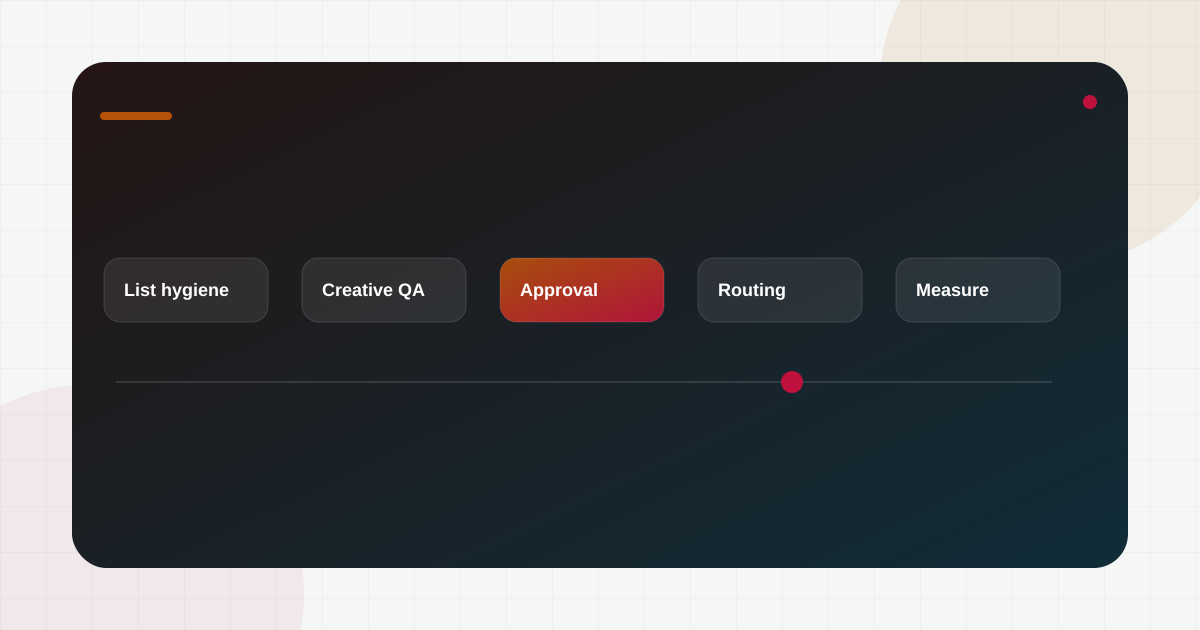
- Campaign operations: replacing per-campaign heroics with a governed library — suppression-first list hygiene, reusable template systems, automated creative QA, and deterministic lead routing. New campaigns start at 60% done.
- Execution governance: approval gates, evidence logs, and launch-readiness checks defined once and applied to everything, so compliance review is a standing gate rather than a launch-week emergency.
- Measurement frameworks: the same five metric families (conversion leverage, automation savings, execution speed, risk reduction, engagement health) applied to every initiative, so success is judged against pre-committed numbers.
None of these are features. All of them compound.
Practical AI, not performative AI
AI adoption fails when it's treated as a separate technology initiative. It works when it's embedded into existing workflows with clear boundaries:
- AI drafts; humans approve. Drafting emails, briefs, and PRDs is a genuine time-saver — as long as approval gates stay human.
- AI routes; systems record. Classification and routing of requests, leads, and content is high-volume, low-risk automation.
- AI summarizes; evidence remains. Management visibility improves when AI condenses activity into reviewable summaries linked to the underlying records.
The test is always the same: did this reduce manual effort, improve customer experience, or speed up a good decision? If not, it's a demo, not a system.
Connecting strategy and execution
Many people can create plans. Many people can execute tasks. The scarce skill is connecting both: taking a business objective, turning it into an execution plan with owners, gates, and metrics, and then making sure it actually ships.
That connective work spans product, operations, marketing, customer communication, and compliance coordination — which is precisely why it's valuable. Problems don't respect functional silos, and neither should the person solving them.
A system review cadence
Before scaling a process, document its trigger, owner, decision rules, handoffs, evidence, exception path, and success measure. Run it manually enough times to find the real variation. Automate stable rules first and keep ambiguous decisions visible to a responsible person.
A monthly system review should ask what still depends on individual memory, which handoff creates the most delay, where quality is detected too late, and whether automation reduced effort without weakening control. The answers become a prioritized operating backlog.
The one-line version
If I had to compress all of this into one sentence, it's the one I use with every growing business I work with:
I help growing businesses scale their operations through better products, smarter processes, and practical AI adoption.
Or, in plainer words: I help businesses grow without creating operational chaos.