

Flagship case study
anonymized evidenceKalkine: Campaign Operations & Lifecycle Automation
Campaign execution was manual, inconsistent across regions, and hard to govern: list hygiene, creative QA, compliance review, and lead handoff all depended on individual effort instead of a repeatable system.
Client context
Kalkine
Role
Product Manager (Campaign Operations + Automation)
Engagement type
Campaign operations design, lifecycle automation, lead-routing systems, and compliance-safe communication programs
Audience
Growth, lifecycle, and revenue-operations teams running multi-region campaign programs
Case study package
Kalkine: Campaign Operations & Lifecycle Automation
Turning multi-region email campaign execution into a governed, automated operating system: suppression-first list hygiene, reusable template libraries, engagement-based lead routing, and automated creative QA.
ProblemCampaign execution was manual, inconsistent across regions, and hard to govern: list hygiene, creative QA, compliance review, and lead handoff all depended on individual effort instead of a repeatable system.
Decision pathSummary, artifacts, outcomes, and methods stay in one reading flow.
Next actionContinue to related thinking or book a call from the page end.
Executive summary
Turning multi-region email campaign execution into a governed, automated operating system: suppression-first list hygiene, reusable template libraries, engagement-based lead routing, and automated creative QA.
Consolidated 15+ live regional campaigns (AU, UK, US, CA) and 7+ cross-region programs into one governed campaign library with region-first placement rules.
Replaced ad-hoc list handling with a suppression-first pipeline: dedupe, seven suppression categories (DNC, unsubscribe, bounce, complaint, converted, compliance hold), and 48-hour send guardrails.
Built a reusable template system (8 base templates plus enhanced variants) with a routing matrix by content type, so new campaigns start from proven assets instead of blank pages.
Automated creative production and QA: scripted banner generation, multi-format export via browser automation, and pixel-validation smoke checks for dimensions, brand zones, and file sizes.
Product showcase
Evidence-led system artifacts.
Public-safe diagrams and sanitized reconstructions; confidential implementation detail is omitted.
Process artifact
Operating checklist
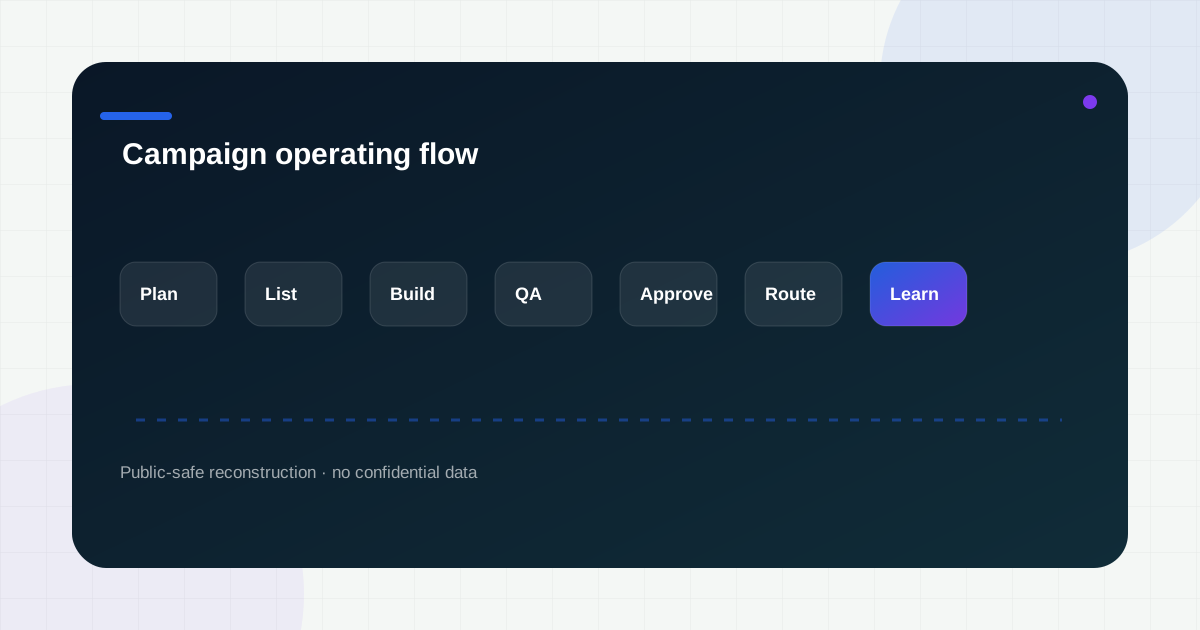
A day-by-day campaign runbook covering list build, segmentation, content QA, send governance, engagement routing, MQL handoff, and sunset rules.
Decision artifact
Engagement routing matrix
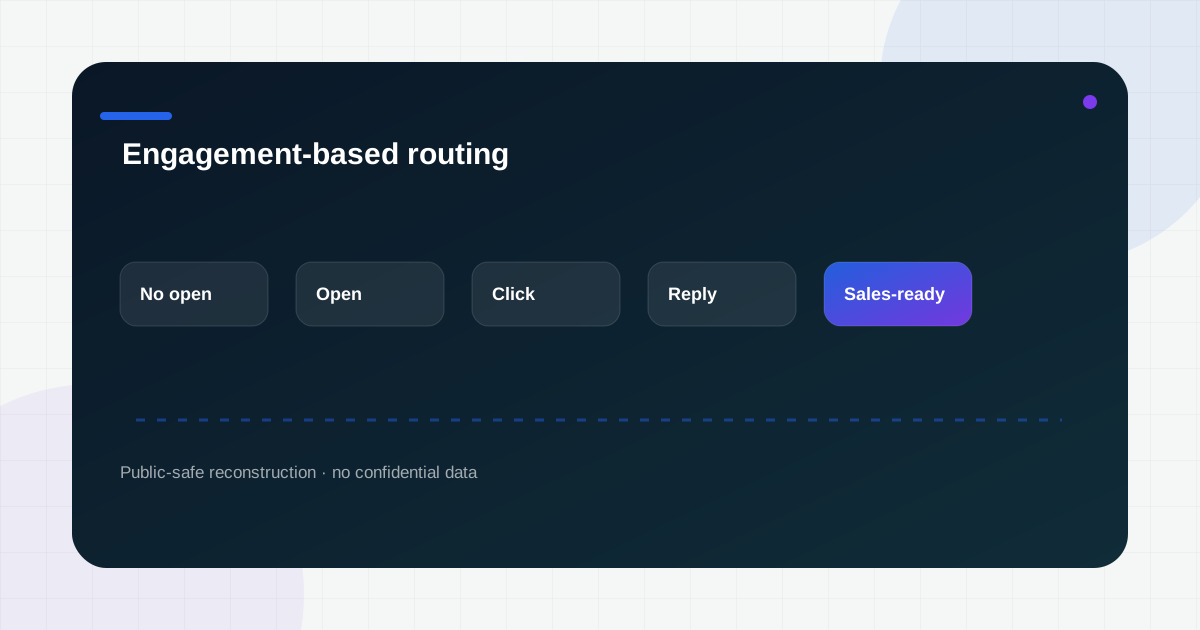
If/else lead-scoring logic that converts opens, clicks, replies, and report requests into follow-up eligibility and sales-ready routing.
Automation artifact
Automated creative pipeline
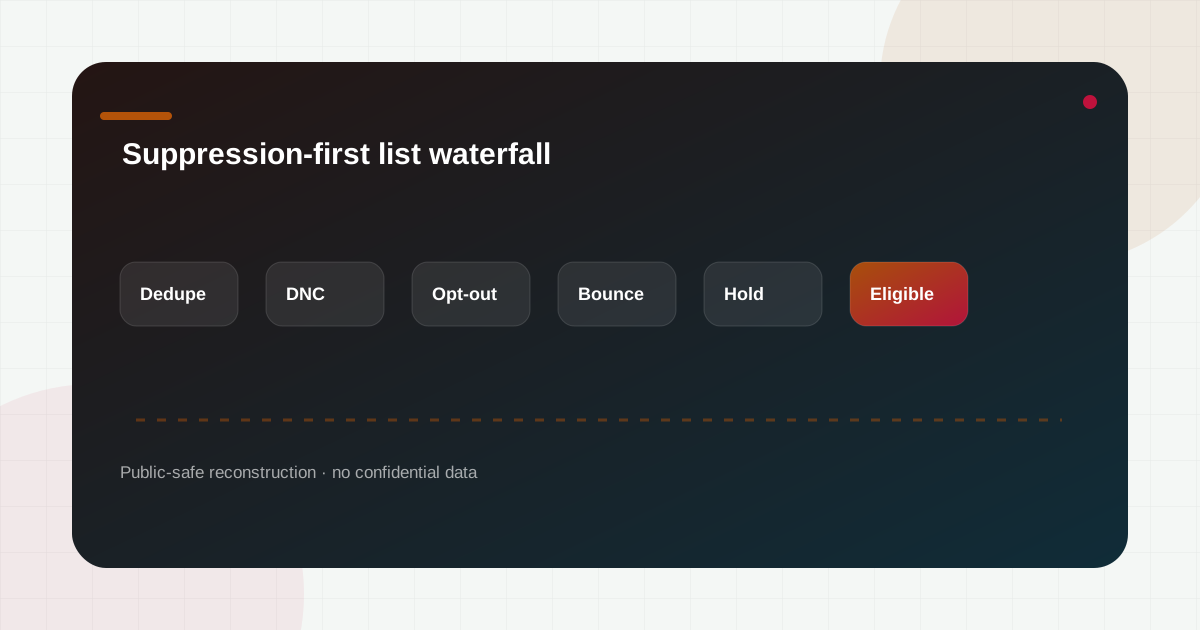
Scripted banner generation, browser-automated multi-format export, and pixel-validation smoke tests replacing manual creative QA.
Outcomes
Campaign execution moved from person-dependent effort to a documented, repeatable operating system with checklists, approval artifacts, and rule-change logs.
List hygiene and compliance stopped being a launch-day scramble: suppression, banned-terms scans, and unsubscribe checks run as standard gates before every send.
Sales handoff quality improved because leads route on explicit intent signals instead of raw volume, protecting sender reputation and sales time.
Creative turnaround compressed: one source-of-truth template generates all banner formats, and automated pixel checks catch defects before human review.
Success signals
KPIs
TL;DR
Multi-region campaign programs fail quietly: lists degrade, creative QA gets skipped under deadline pressure, compliance review becomes a bottleneck, and sales receives unqualified leads.
I treated campaign execution as a product problem. Instead of running campaigns one at a time, I built the operating system around them: governed lists, reusable templates, automated creative QA, deterministic lead routing, and documented checklists that any team member can run.
The result is a campaign function that scales across four markets without scaling headcount or chaos.
1) The problem
Kalkine runs research-led campaigns across AU, UK, US, and CA: seasonal bundles, product launches, lead magnets, re-engagement sequences, referral programs, and compliance-sensitive consent flows.
Executed manually, this created predictable failure modes:
- List risk: duplicates, lapsed consent, and suppressed contacts slipping into sends
- Creative risk: banner and template defects caught late or shipped
- Compliance risk: banned promotional language and missing disclaimers surfacing in review, or worse, after launch
- Routing waste: sales receiving raw responder lists instead of intent-qualified leads
- Person dependency: execution knowledge living in individuals rather than the system
2) The operating model
I organized the program around a repeatable weekly/monthly loop:
list build -> segmentation -> content QA -> send governance -> engagement routing -> sales handoff -> sunset/suppression
Suppression-first list hygiene
Every send starts from a master list processed through a suppression cascade: do-not-contact, unsubscribes, bounces, complaints, converted customers, and compliance holds, deduplicated by email, with a 48-hour guardrail between touches. List changes are logged with audit files so removals are transparent and reversible.
Reusable template system
Instead of designing each campaign from scratch, the program uses a library of eight base templates with enhanced variants, routed by content type: monthly recommendations, thematic deep-dives, soft re-engagement, income-report, article-led, and weekly digest formats. Copy decks standardize subject lines, preheaders, CTA labels, and compliance wording.
Automated creative pipeline
Banner creative is generated from a single source-of-truth HTML template and exported to all required formats through browser automation. A pixel-validation smoke script checks dimensions, brand color zones, and file sizes before any human review. QA became a gate, not a favor.
Deterministic engagement routing
Lead routing follows explicit, binary rules:
- No open: no follow-up
- Open or click: eligible for the engaged follow-up track
- Reply, report request, or repeated clicks: sales-ready (when phone data is present)
- Two consecutive no-opens: soft re-engagement
- Five no-opens: suppress unless new consent arrives
This replaced spray-and-pray frequency with signal-based qualification, protecting both sender reputation and sales time.
3) Governance and compliance by design
Financial-services communication cannot rely on goodwill. The program embeds governance as standing gates:
- Content QA gates: HTML/text parity, preheader presence, a three-link maximum, and automated banned-terms scans (no "guaranteed", "risk-free", "last chance")
- Send governance: bounce and complaint monitoring, unsubscribe rendering checks, sender identity verification
- Approval artifacts: campaign approvals tracked as files, not chat messages
- Rule-change log: every routing or suppression rule change recorded with date and reason
- General-information guardrails: no personal-suitability language in any customer-facing template
4) How impact is measured
The program tracks five leverage categories:
- Revenue and conversion leverage: campaign-influenced conversions vs organic baseline, conversion recovery after campaign execution improvements, and campaign-wise conversion output
- Cost-saving and automation leverage: manual touchpoints removed, workflows automated, and time saved per campaign cycle
- Execution speed: idea-to-draft, draft-to-approval, and approval-to-launch times per campaign
- Governance and risk reduction: approval gates completed, compliance touchpoints passed, blockers caught before exposure, and evidence logs maintained
- Engagement health: open, click, reply, and opt-out rates, plus re-engagement and renewal behavior downstream
Where exact numbers are commercially sensitive, this case study describes the measurement system rather than publishing figures.
5) What I learned
- Suppression discipline is a growth feature. Cleaner lists convert better and protect deliverability, which compounds across every future campaign.
- Templates are leverage, not constraints. A governed library made campaigns faster and more consistent without flattening creative quality.
- Binary routing rules beat judgment calls. When follow-up eligibility is deterministic, marketing and sales stop arguing about lead quality.
- Automate the QA humans skip under pressure. Pixel checks and banned-terms scans run every time; tired reviewers do not.
This case study presents a public-safe summary of the work.
Related thinking
Methods used
Have a similar product problem?