

Case study
Documented workVerified AI Governance Operating System
AI-assisted work can move quickly, but without evidence, approval boundaries, storage proof, and replayable audit, it becomes difficult to trust or reuse.
Context
Independent flagship system
Role
Founder / Product Systems Builder
Engagement type
AI governance, product operations, workflow design, and platform proof
Audience
AI product teams, operators, founders, and hiring teams evaluating product-system depth
The approach at a glance
Verified AI Governance Operating System
Executive summary
How I designed a governed decision loop that connects AI recommendations to source evidence, human approval, execution and review.
Positions AI as a routing and drafting layer, not the source of truth.
Turns capture, memory, decision, approval, execution, audit, and learning into one governed operating loop.
Separates local fallback from production-grade canonical storage proof.
Packages product strategy, operator truth, system truth, backlog, brand governance, and Career OS into connected surfaces.
Product showcase
Decisions made visible.
These diagrams explain the approach, with confidential implementation details omitted.
Architecture artifact

Governed operating spine
The core loop maps capture, memory, decision, approval, execution, audit, and learning into one reviewable system.
Runtime surface

Operator Truth control plane
A governed view for recommendations, approval state, execution records, audit lineage, replay, and learning output.
Trust artifact

Storage proof boundary
The product explicitly distinguishes local fallback from canonical Graph and Cosmos production readiness.
Outcomes
Connected recommendations, human approval and execution in one inspectable decision loop.
Preserved a bounded end-to-end trace so a reviewer can follow the evidence, decision and resulting action.
Established a product architecture that makes provenance, approval, and audit visible before AI-assisted output is treated as trusted.
Success signals
KPIs
TL;DR
This governed execution system is my flagship product-system bet: a verified AI governance operating system for turning AI-assisted work into durable evidence, explicit decisions, approved execution, audit trails, and reusable learning.
The core idea is simple:
AI can draft and route, but the system must prove what happened, why it happened, who approved it, where it was stored, and what can be reused.
This is not designed to be another generic chatbot. It is designed to be the trust layer around AI-assisted work.
1) The problem
Most AI workflows optimize for speed first. That creates immediate output, but weakens trust when teams later need to answer:
- What evidence supported this recommendation?
- Which source or artifact did the AI use?
- Who approved the state-changing action?
- Was the result stored in the canonical system or only in local fallback?
- Can the run be replayed or audited?
- What did the system learn for next time?
Without those answers, AI output becomes a wrapper around uncertainty.
2) Product thesis
The system treats AI as a useful drafting and routing layer, not as the source of truth.
The product promise is verified AI governance:
- evidence grounding
- decision rationale
- human approval boundaries
- canonical artifact/state storage
- audit lineage
- replay/debug visibility
- evals for AI quality and refusal behavior
- reusable learning records
The long-term moat is not prompt polish. The moat is provenance.
3) The operating loop
The flagship loop is:
capture -> memory -> decision -> approval -> execution -> audit -> learning
Each step exists to reduce ambiguity:
- Capture: collect the work request, evidence, and context.
- Memory: retrieve prior decisions, artifacts, and reusable patterns.
- Decision: evaluate options and recommend a next action with rationale.
- Approval: gate state-changing work behind explicit human review.
- Execution: run approved actions through a traceable path.
- Audit: preserve what happened, when, why, and by whom.
- Learning: convert outcomes into reusable future guidance.
4) What makes it non-trivial
This system is difficult to build because it sits between product strategy, workflow orchestration, governance, storage, and AI safety.
The hard parts are not just UI screens. The hard parts are boundaries:
- local fallback versus production truth
- draft output versus approved output
- recommendation versus execution
- imported evidence versus canonical runtime state
- AI-generated content versus human-approved artifact
- documentation intent versus implementation truth
Those boundaries are where trust is either earned or lost.
5) Current proof and confidence gates
The current proof stack emphasizes focused confidence over broad theater:
- strict storage health that reaches Graph-backed SharePoint and Cosmos state in canonical mode
- a runtime-backed Golden Loop proof with capture, decision, approval, blueprint, execution, audit, and learning lineage
- generated JSON, Markdown, and Word-compatible exports with runtime truth kept separate from portable output
- focused route and workflow tests that make missing evidence and unsafe transitions visible
- an explicit active, learned, and postponed proof register so inactive work does not distort priority or lifecycle counts
The confidence strategy remains intentionally focused: prove the changed workflow, storage boundary, and public claim before expanding surface area.
6) What is still missing
The next credibility step is outcome and AI-quality depth:
-
AI eval fixtures Career OS and GPT action surfaces need tests for evidence grounding, unsupported claim refusal, JD-tailoring faithfulness, and unsafe-action refusal.
-
Quality and operating metrics Add visible measures for task completion, reliability, latency, cost, adoption, or time saved where evidence is available.
-
External-user proof Add a sanitized discovery-to-learning trace showing how real user or stakeholder evidence changed the roadmap.
-
Prototype-to-learning proof Show one AI feature that was tested, changed, rejected, or narrowed because the evidence did not support the first idea.
-
Public outcome learning Track which proof assets generate qualified product conversations rather than relying on surface engagement.
7) What this means for your team
The useful question is what happens after an AI recommendation. Can someone understand its source, challenge the decision, approve the next step and review the result?
This work connects those responsibilities in one product model. For a team adopting AI, that provides a practical starting point for deciding which actions need human review, what evidence should travel with them and how to investigate a result later.
My contribution spans the product decisions and the delivery: mapping the workflow, defining approval boundaries, building the trace and checking what the evidence actually supports.
8) Recorded storage check
On 2026-07-14, the strict runtime health check reached both configured canonical backends:
- Microsoft Graph-backed SharePoint for artifact storage
- Azure Cosmos DB for governed runtime state
This records backend reachability at that review date. It is separate from the earlier local execution trace and is not a continuous health or production-reliability claim. User adoption, model quality and business impact require their own evidence.
9) Where validation goes next
The bounded trace below covers a request moving through decision, approval, execution, audit and learning. A broader rollout needs evidence beyond that trace: repeated user journeys, reliability checks and evaluation of unsupported or unsafe recommendations.
I would use a small evaluation set with clear failure categories and a quality threshold, then review how human approval handles the difficult cases. That evidence should shape the next product decision.
Proof Artifact: Operator Truth Trace v1
This proves I can design and ship AI systems where every state-changing decision is inspectable, which is the discipline required for AI in regulated, high-trust, or enterprise environments.
This gallery preserves the earlier local-development trace as historical evidence. The separate dated storage check is documented above.
60-second proof
This proof captures one bounded operator request and shows the governed loop end-to-end:
capture -> decision -> approval -> run -> command -> output -> audit -> learning.
Proof status: complete trace proof.
What this proves
- A live request moved through the Operator Truth loop and reached execution in the governed runtime.
- The trace retains explicit decision, approval, run, output, and audit continuity.
- The storage posture and trust boundary are explicitly labeled as local-dev fallback.
What this does not prove
- It is not full autonomous production execution.
- It is not canonical Graph/SharePoint or canonical Cosmos persistence proof.
- A separate mature human approval inbox is not claimed in this proof.
Evidence gallery
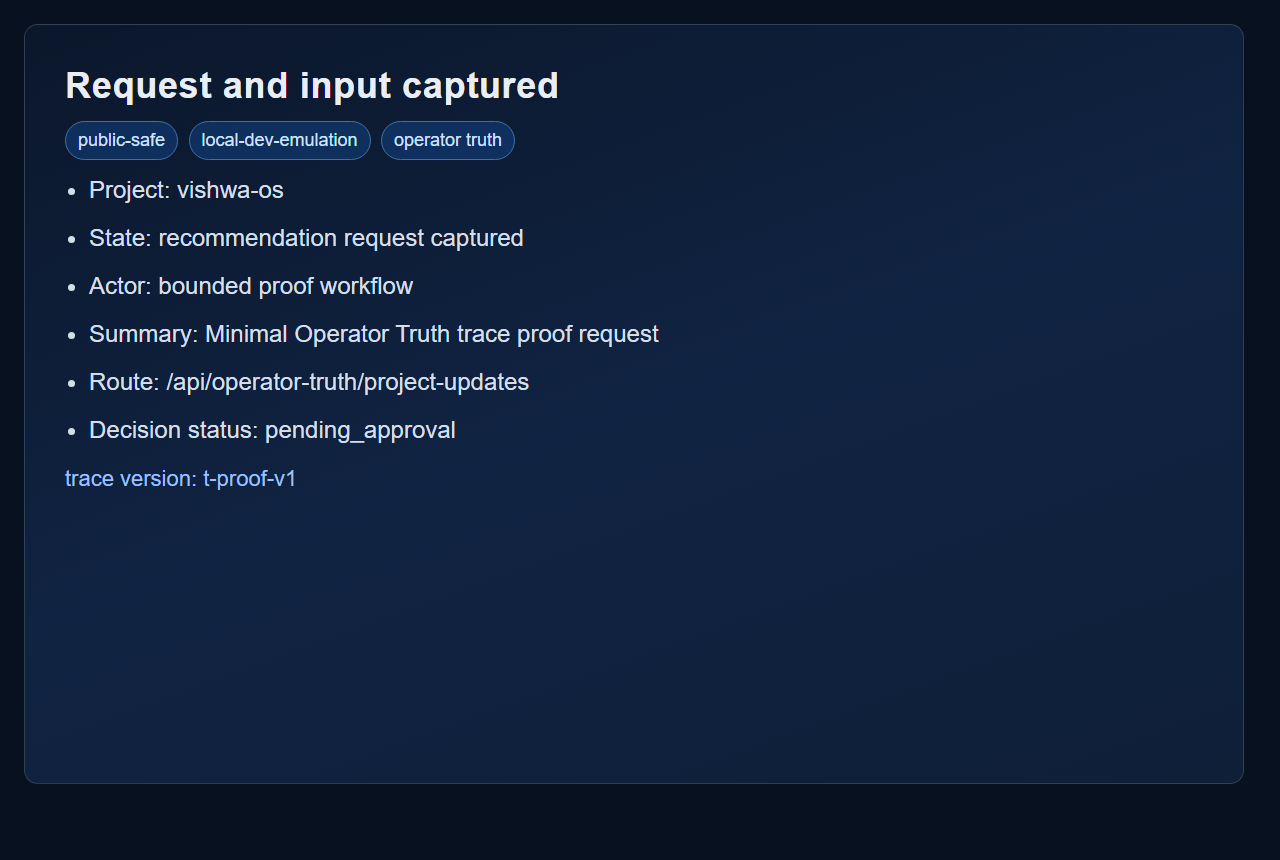
artifact -> recommendation capture with bounded local-dev trace inputs.
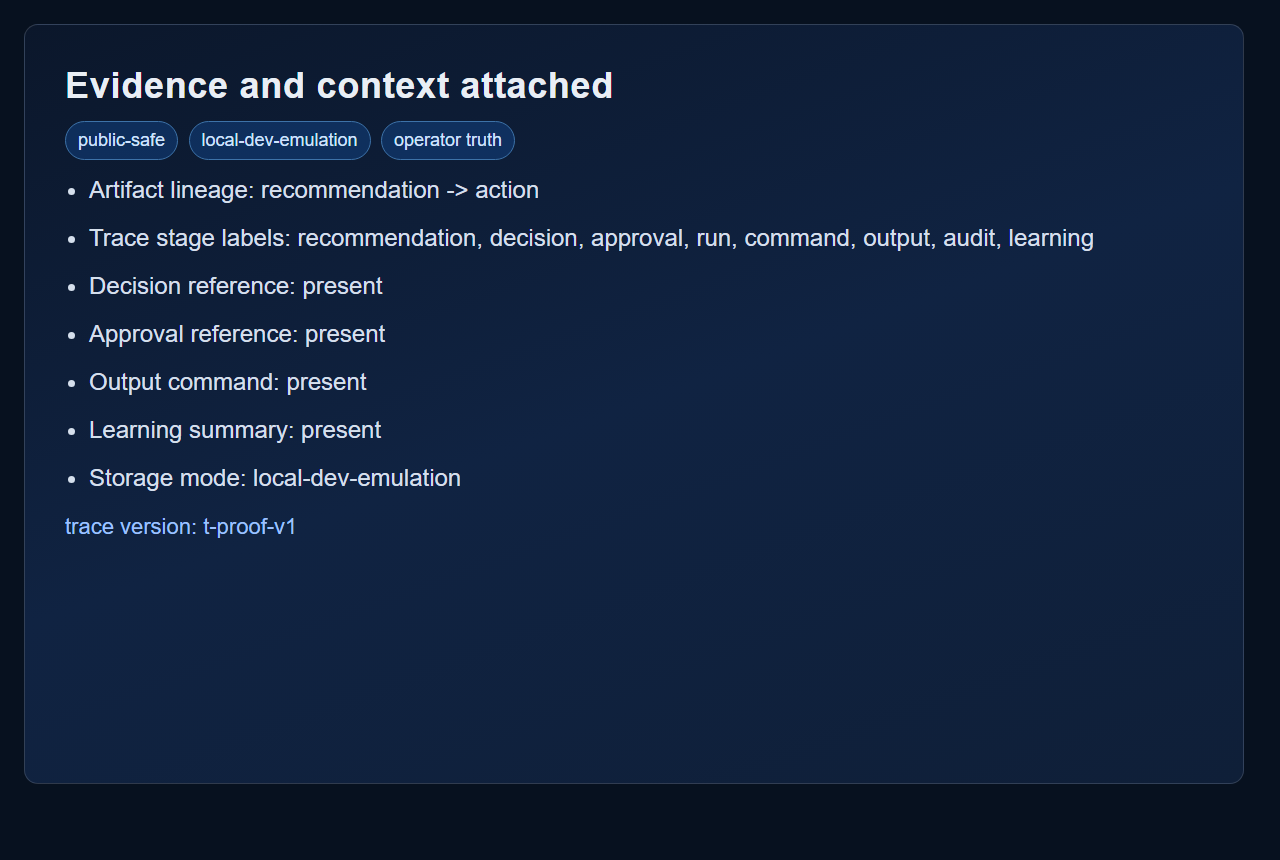
evidence -> provenance -> policy checks in one review panel.
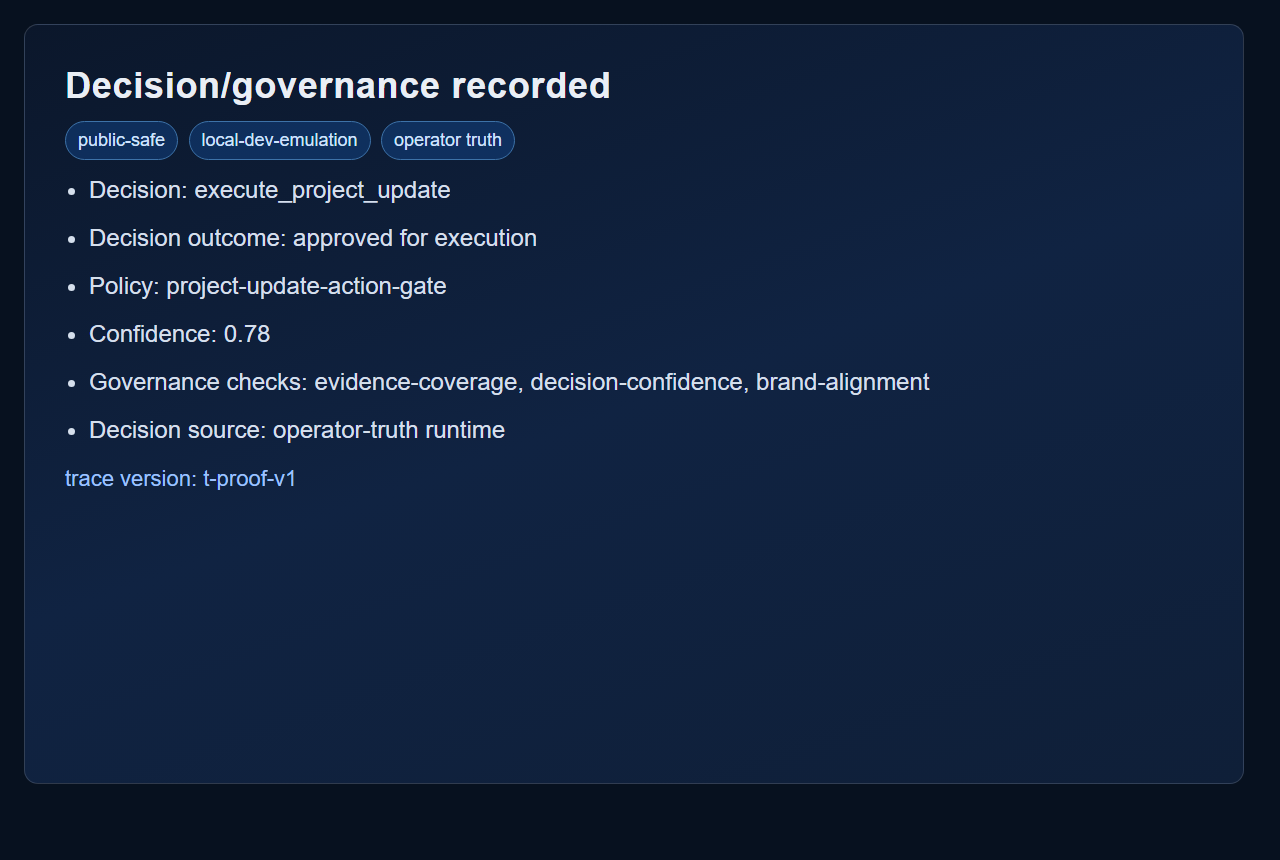
decision packet, confidence signals, and governance boundaries.
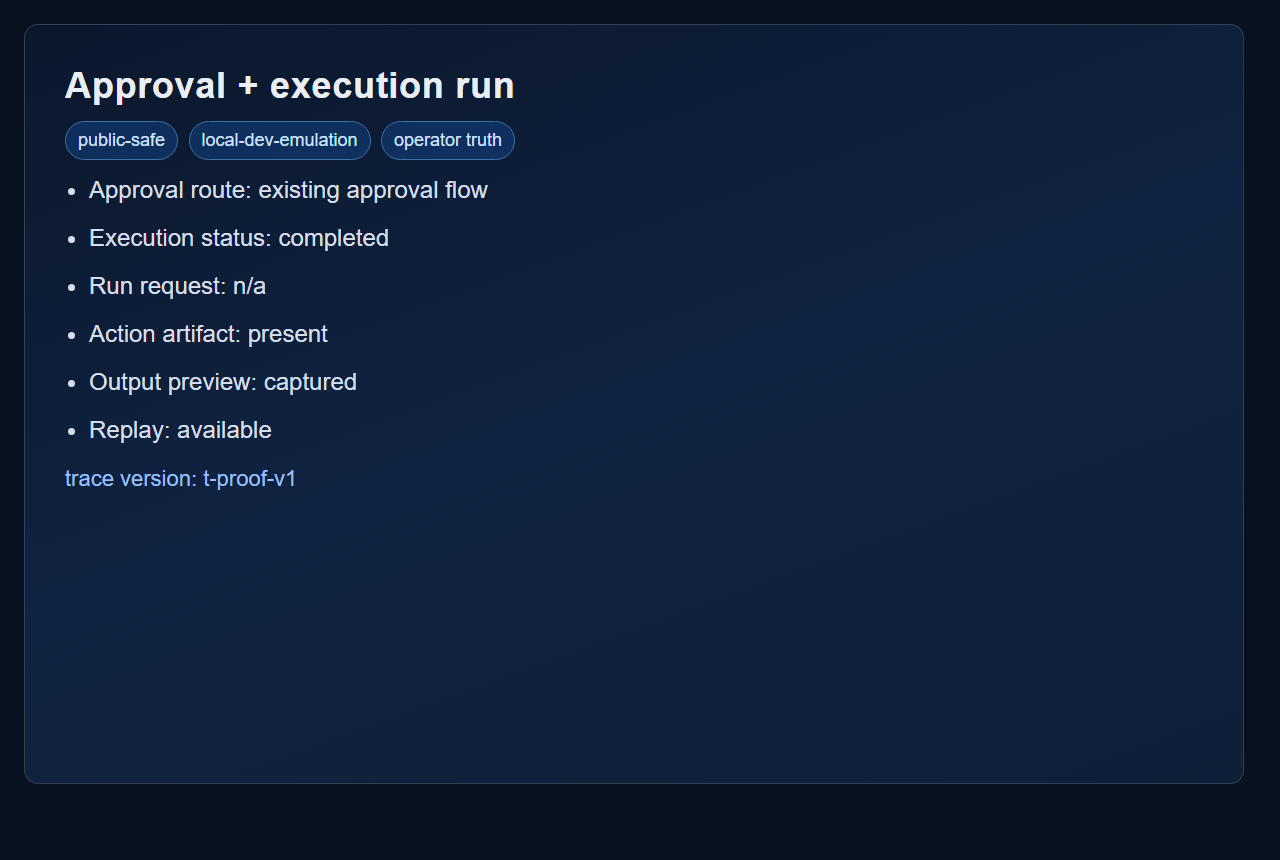
approval route, run replay metadata, and command completion.
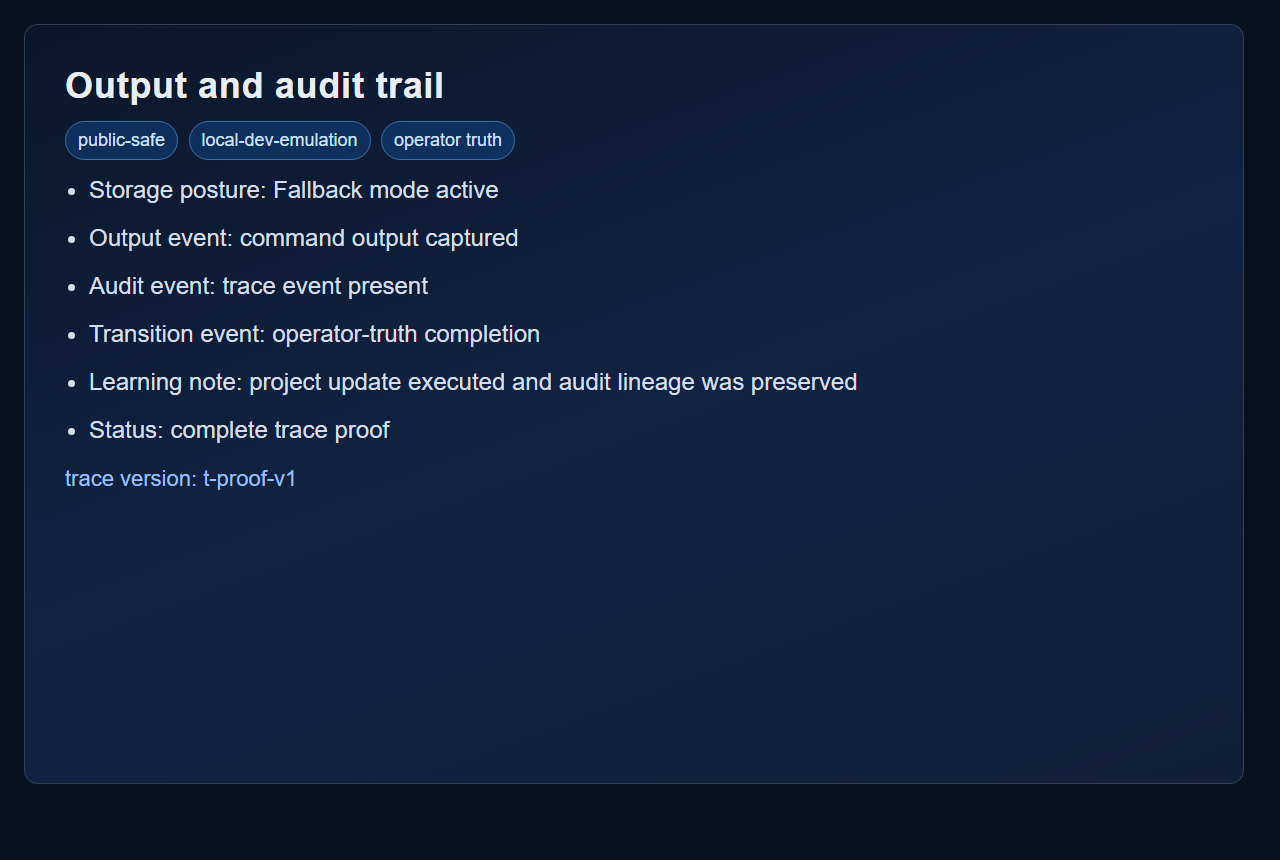
output capture, audit trail continuity, and learning artifact handoff.
Source of truth references:
proof/operator-truth-trace/public/operator-truth-trace-v1.mdproof/operator-truth-trace/public/proof-manifest.json
Historical trace posture
- Claim level:
minimal-governed-trace-proof - Current statement: bounded proof slice, local-dev fallback.
- Production claim:
false - Storage posture:
fresh-local-devwith local fallback.
Next validation
- Operator approval was recorded through the existing approval route.
- Canonical Graph and Cosmos reachability has since been verified through the strict runtime health path.
- Add AI evaluation, real-user outcome, and reliability evidence before making broader product-impact claims.
Related thinking
Methods used
Have a similar product problem?