

AI workflows optimize for speed first. That produces immediate output — and delayed regret, because sooner or later someone asks:
- What evidence supported this recommendation?
- Who approved the state-changing action?
- Was the result stored in the canonical system or just somewhere convenient?
- Can we replay what happened?
If the answers are shrugs, the AI output was a wrapper around uncertainty. Building a governed execution system taught me a pattern that prevents this without killing velocity.
The governed loop
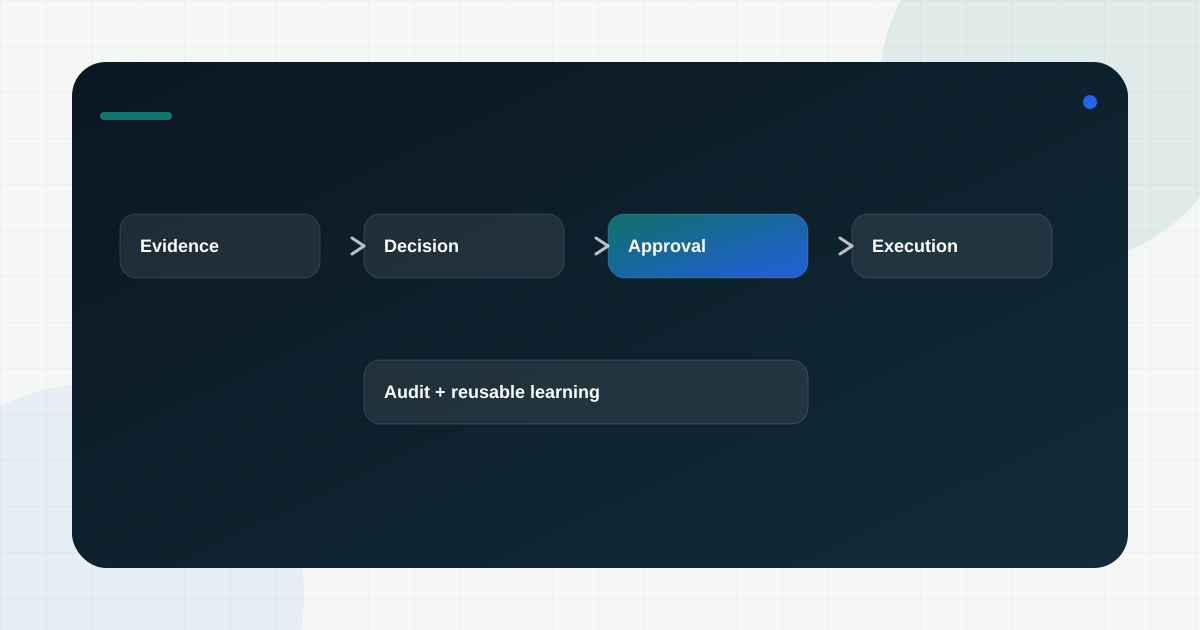
Every AI-assisted piece of work moves through the same seven states:
capture -> memory -> decision -> approval -> execution -> audit -> learning
- Capture: collect the request, evidence, and context as a durable artifact — not a chat message.
- Memory: retrieve prior decisions and reusable patterns before generating anything new.
- Decision: produce a recommendation with rationale and confidence, packaged as a reviewable decision packet.
- Approval: gate every state-changing action behind explicit human review. AI can propose; only people approve.
- Execution: run approved actions through a traceable path with step-level records.
- Audit: preserve what happened, when, why, and by whom — linked, not scattered.
- Learning: convert the outcome (approved, rejected, revised) into guidance the system reuses next time.
None of these steps is exotic. The discipline is refusing to skip them when deadlines press.
The boundaries that earn trust
The hard part of AI governance isn't screens; it's boundaries. Five distinctions do most of the work:
- Draft vs approved. AI-generated content stays visibly in draft status until a human promotes it. No silent auto-publish.
- Recommendation vs execution. The system may recommend an action with full rationale, but recommendation and execution are separate records with separate permissions.
- Local fallback vs canonical storage. If output landed in a temp store instead of the system of record, the UI should say so. Storage posture is a trust signal, not an implementation detail.
- Imported evidence vs runtime state. Documents brought in as evidence are provenance-tagged and never confused with the system's own authoritative state.
- AI surface vs governance surface. External AI interfaces (assistants, GPT actions) get read-and-draft access only. They cannot approve, execute, or bypass gates by construction — not by policy document.
What this looks like in practice
A concrete slice: a work request arrives, evidence is attached, and the system generates a decision packet with rationale. A human reviews it — approve, revise, or reject. On approval, a bounded action executes with every step recorded. The audit trail links request, evidence, decision, approval, execution, and output under one trace ID. Finally, a learning record captures what worked, so the next similar request starts smarter.
The payoff shows up in numbers a business cares about:
- Risk reduction you can count: approval gates completed, blockers caught before exposure, evidence logs maintained.
- Faster reviews: approvers see a structured packet with evidence and rationale, not a wall of AI prose.
- Reuse: learning records mean the second campaign, PRD, or workflow of a given type is meaningfully cheaper than the first.
Quality gates for the AI itself
Human approval catches bad actions; it shouldn't be the only line of defense against bad content. Deterministic checks run before anything reaches a reviewer: unsafe-action refusal, high-risk claim detection, and evidence-grounding warnings when generated text asserts something no source supports.
These evals are boring and that's the point. Governance that depends on reviewer vigilance degrades under load; governance encoded as checks does not.
Start with a narrow confidence gate
A small governed loop with complete evidence is more valuable than a broad assistant whose actions cannot be explained. Constrain the first release to one source set, one decision type, one approver, and one reversible action.
Where to start
You don't need a platform to adopt this. Start with one workflow that changes state — publishing, sending, spending — and add three things: a captured decision record with evidence, an explicit human approval step, and a linked audit log. Expand only after that loop survives real usage.
Faster output is useful. Trusted output is the product.