

Architecture artifact
Governed operating spine
The core loop maps capture, memory, decision, approval, execution, audit, and learning into one reviewable system.
Case study
AI-assisted work can move quickly, but without evidence, approval boundaries, storage proof, and replayable audit, it becomes difficult to trust or reuse.
Client context
Independent flagship system
Role
Founder / Product Systems Builder
Engagement type
AI governance, product operations, workflow design, and platform proof
Audience
AI product teams, operators, founders, and hiring teams evaluating product-system depth
Case study package
Vishwa OS: Verified AI Governance OS

A flagship product-system case study for turning AI-assisted work into evidence-backed decisions, approvals, audit trails, replayable execution, and reusable learning.
ProblemAI-assisted work can move quickly, but without evidence, approval boundaries, storage proof, and replayable audit, it becomes difficult to trust or reuse.
Decision pathSummary, artifacts, outcomes, and methods stay in one reading flow.
Next actionContinue to related thinking or book a call from the page end.
Executive summary
A flagship product-system case study for turning AI-assisted work into evidence-backed decisions, approvals, audit trails, replayable execution, and reusable learning.
Positions AI as a routing and drafting layer, not the source of truth.
Turns capture, memory, decision, approval, execution, audit, and learning into one governed operating loop.
Separates local fallback from production-grade canonical storage proof.
Packages product strategy, operator truth, system truth, backlog, brand governance, and Career OS into connected surfaces.
Product showcase
Architecture artifact
The core loop maps capture, memory, decision, approval, execution, audit, and learning into one reviewable system.
Runtime surface
A governed view for recommendations, approval state, execution records, audit lineage, replay, and learning output.
Trust artifact
The product explicitly distinguishes local fallback from canonical Graph and Cosmos production readiness.
Outcomes
Created a differentiated career thesis around verified AI governance instead of generic assistant UI work.
Converted scattered project work into a compounding loop: daily work -> governed evidence -> public proof -> opportunity conversion -> reusable learning.
Established a product architecture that makes provenance, approval, and audit visible before AI-assisted output is treated as trusted.
Success signals
KPIs
Vishwa OS is my flagship product-system bet: a verified AI governance operating system for turning AI-assisted work into durable evidence, explicit decisions, approved execution, audit trails, and reusable learning.
The core idea is simple:
AI can draft and route, but the system must prove what happened, why it happened, who approved it, where it was stored, and what can be reused.
This is not designed to be another generic chatbot. It is designed to be the trust layer around AI-assisted work.
Most AI workflows optimize for speed first. That creates immediate output, but weakens trust when teams later need to answer:
Without those answers, AI output becomes a wrapper around uncertainty.
Vishwa OS treats AI as a useful drafting and routing layer, not as the source of truth.
The product promise is verified AI governance:
The long-term moat is not prompt polish. The moat is provenance.
The flagship loop is:
capture -> memory -> decision -> approval -> execution -> audit -> learning
Each step exists to reduce ambiguity:
Vishwa OS is difficult because it sits between product strategy, workflow orchestration, governance, storage, and AI safety.
The hard parts are not just UI screens. The hard parts are boundaries:
Those boundaries are where trust is either earned or lost.
The current proof stack emphasizes focused confidence over broad theater:
The confidence strategy remains intentionally focused: prove the changed workflow, storage boundary, and public claim before expanding surface area.
The next credibility step is outcome and AI-quality depth:
AI eval fixtures Career OS and GPT action surfaces need tests for evidence grounding, unsupported claim refusal, JD-tailoring faithfulness, and unsafe-action refusal.
Quality and operating metrics Add visible measures for task completion, reliability, latency, cost, adoption, or time saved where evidence is available.
External-user proof Add a sanitized discovery-to-learning trace showing how real user or stakeholder evidence changed the roadmap.
Prototype-to-learning proof Show one AI feature that was tested, changed, rejected, or narrowed because the evidence did not support the first idea.
Public outcome learning Track which proof assets generate qualified product conversations rather than relying on surface engagement.
This project is intentionally built to show more than coding output.
It demonstrates:
For career growth, Vishwa OS should be the flagship story because it shows how I think about the future of AI-enabled work: faster output is useful, but trusted output is the real product.
On 2026-07-14, the strict runtime health check reached both configured canonical backends:
This closes the storage gap described in the earlier local proof. It does not by itself prove user adoption, model quality, or business impact; those remain separate evidence requirements.
The next public milestone should be a narrow demo slice:
Take one messy work request, capture evidence, generate a decision packet, approve it, execute a bounded action, preserve the audit trail, and emit a reusable learning record.
The next milestone is an AI evaluation proof: use a small golden set, define failure categories and a quality threshold, show how human review handles unsafe or unsupported output, and record how the result changes the roadmap.
This proves I can design and ship AI systems where every state-changing decision is inspectable, which is the discipline required for AI in regulated, high-trust, or enterprise environments.
This gallery preserves the earlier local-development trace as historical evidence. The current canonical storage posture is documented separately above.
This proof captures one bounded operator request and shows the governed loop end-to-end:
capture -> decision -> approval -> run -> command -> output -> audit -> learning.
Proof status: complete trace proof.
vishwa-os.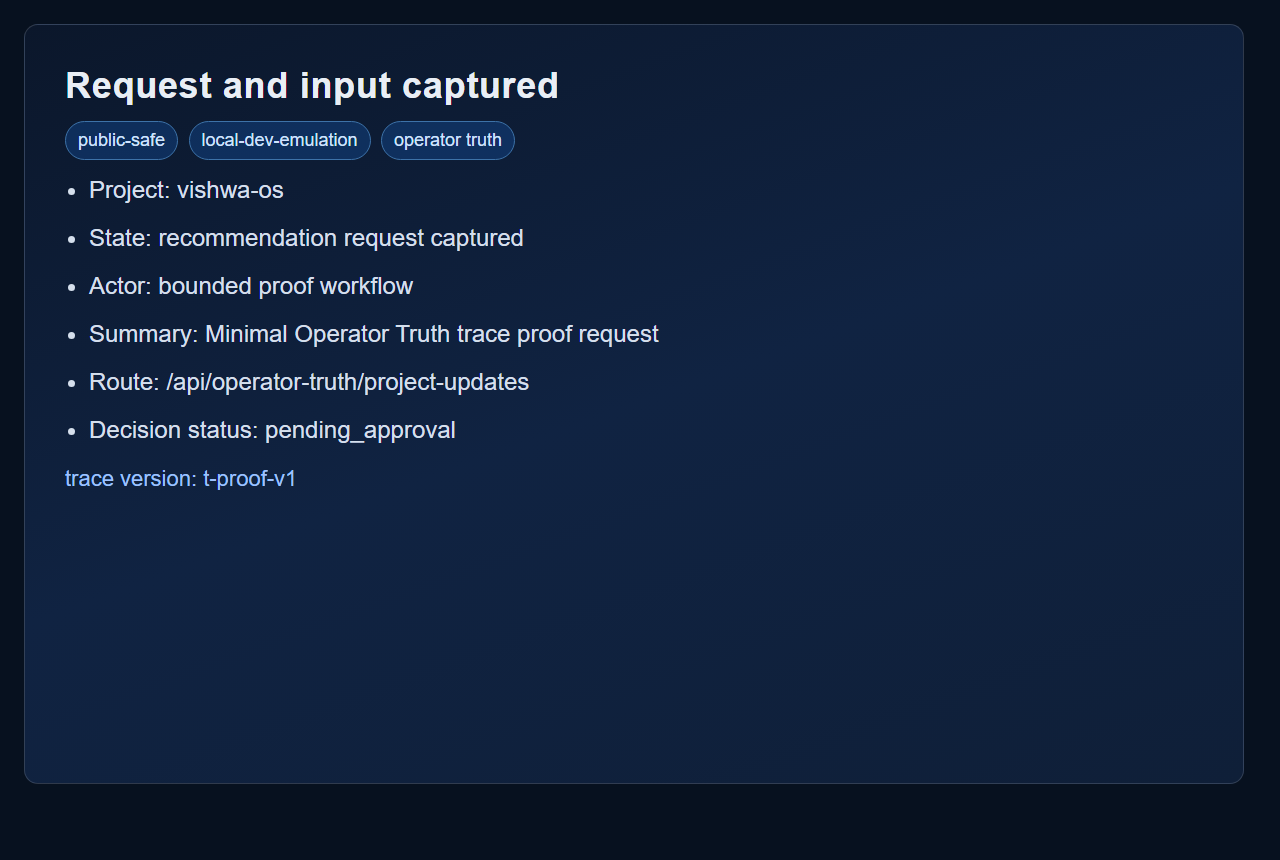
artifact -> recommendation capture with bounded local-dev trace inputs.
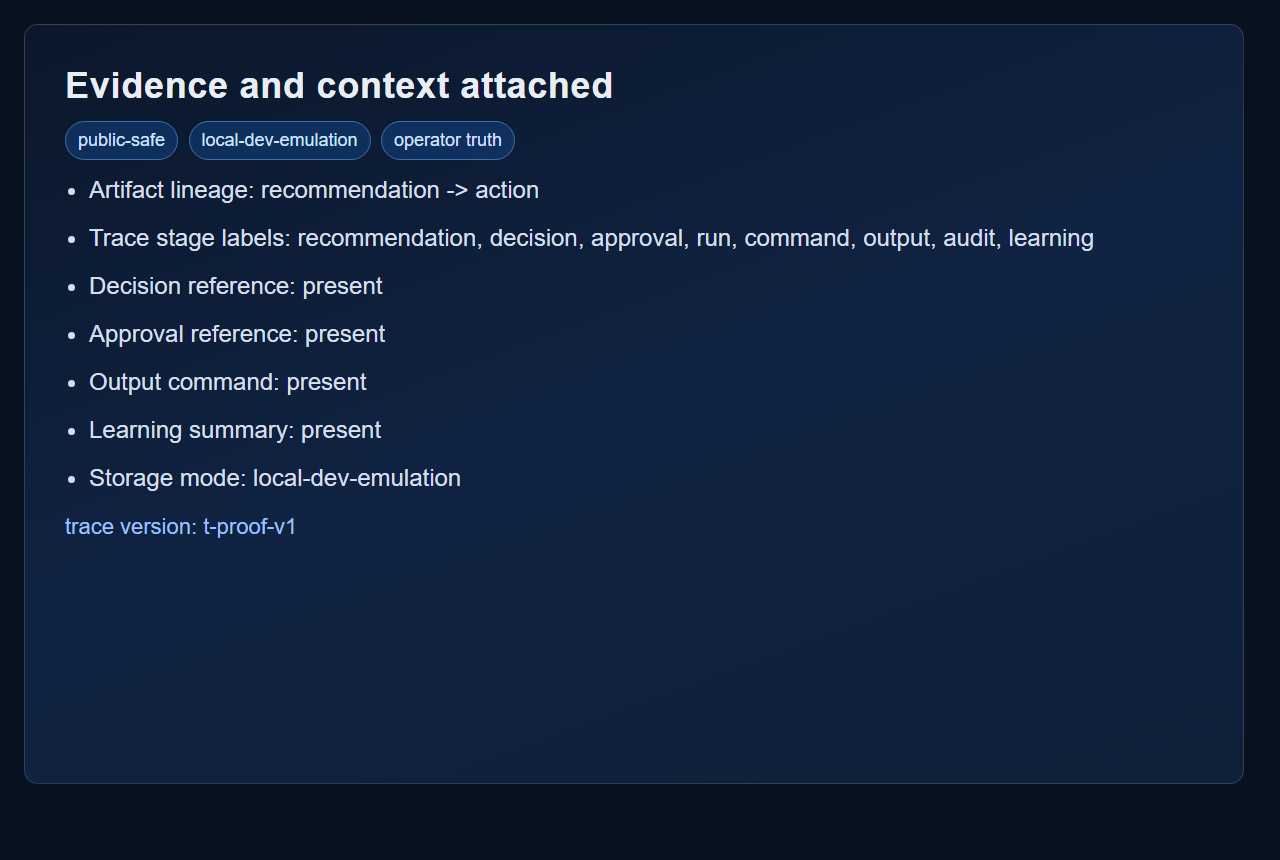
evidence -> provenance -> policy checks in one review panel.
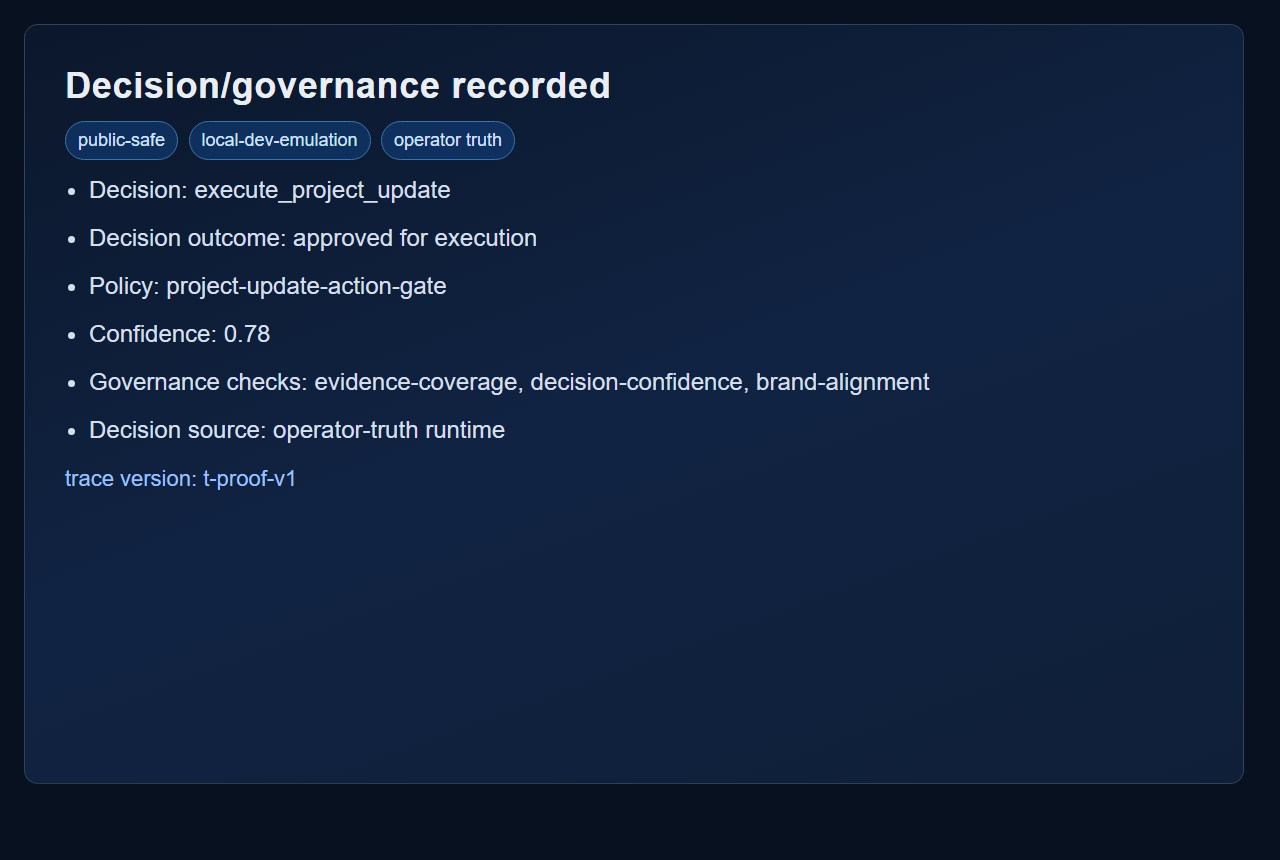
decision packet, confidence signals, and governance boundaries.
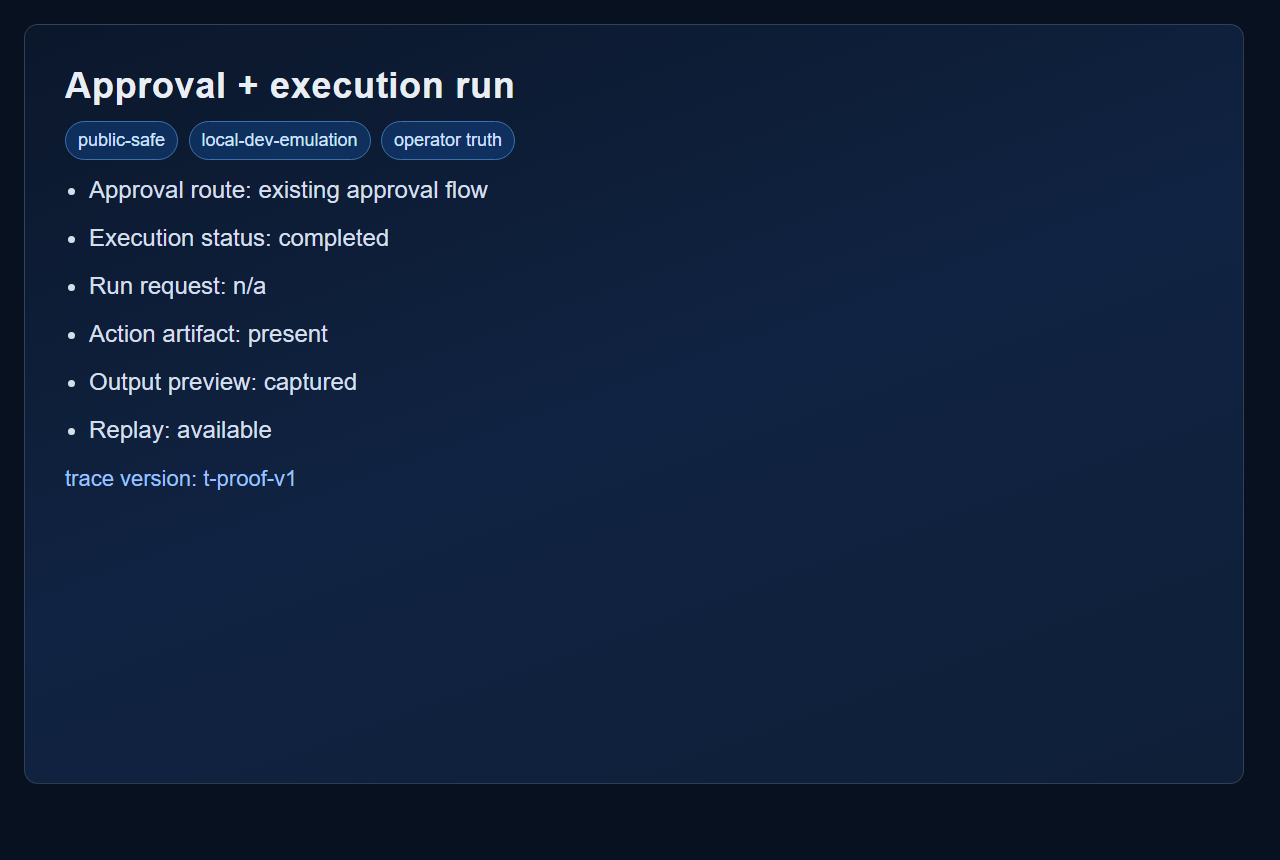
approval route, run replay metadata, and command completion.
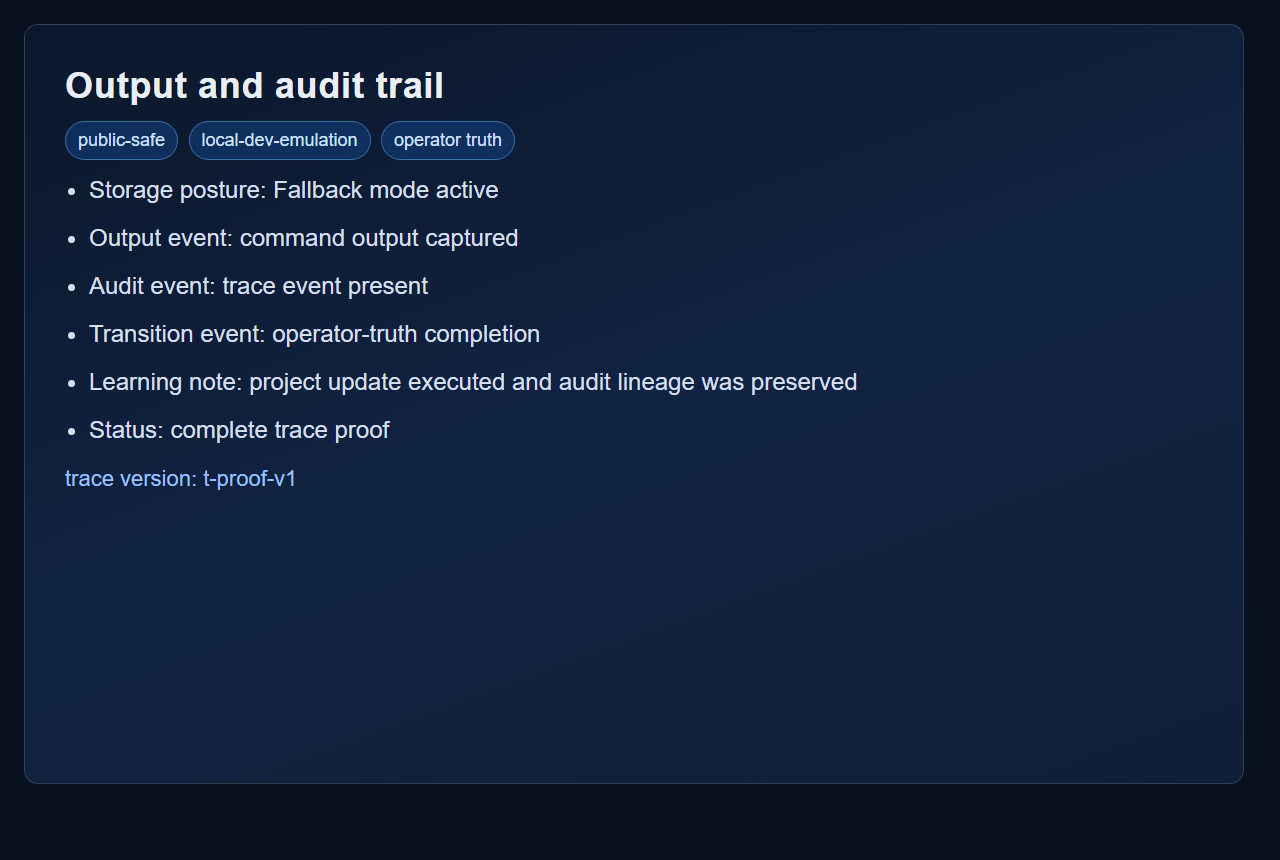
output capture, audit trail continuity, and learning artifact handoff.
Source of truth references:
proof/operator-truth-trace/public/operator-truth-trace-v1.mdproof/operator-truth-trace/public/proof-manifest.jsonminimal-governed-trace-prooffalsefresh-local-dev with local fallback.Related thinking
Methods used
Have a similar product problem?