

Product architecture
Currency-aware net-worth model
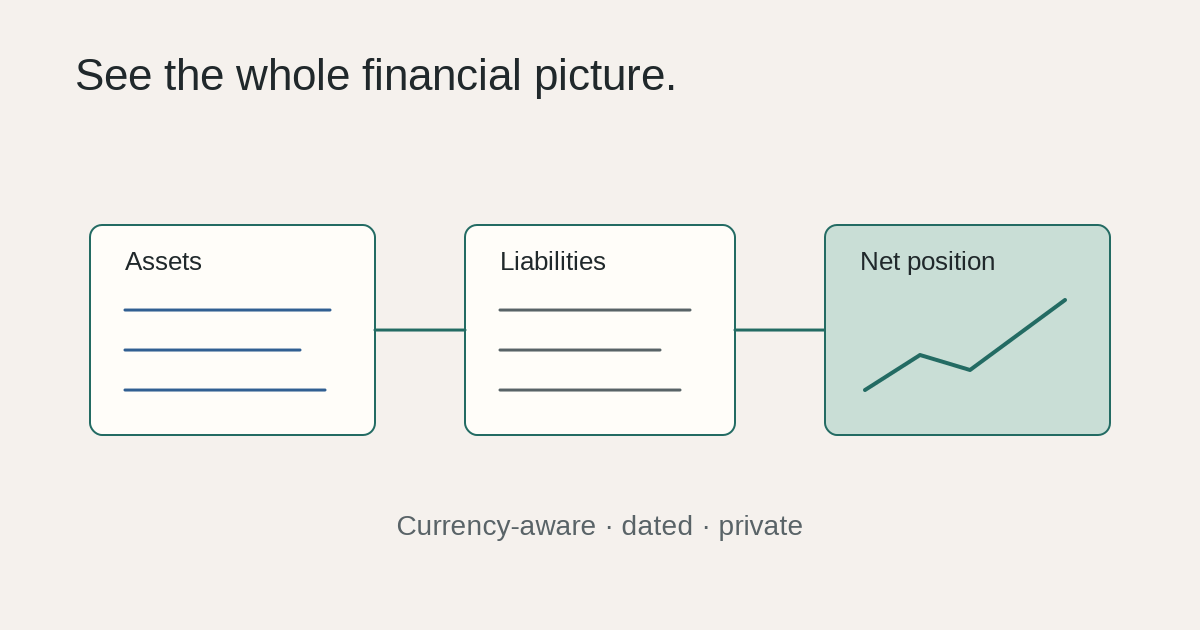
Assets and liabilities retain their source currency and valuation date, so the UI can explain the position without inventing a conversion.
Case study
Documented workPeople can hold investments, cash, property and liabilities across several places while their portfolio product shows only part of the picture. The product needed a private way to assemble dated balances without implying false precision or combining unlike currencies.
Context
StockNextt
Role
Product lead and engineer
Engagement type
Fintech product strategy, information architecture, account-scoped data systems and production-ready responsive delivery
Audience
Self-directed investors who want a clearer view across portfolios and the rest of their balance sheet
The approach at a glance
StockNextt Wealth OS
Executive summary
Designing and engineering a private workspace that connects portfolios, assets, liabilities and dated balances into a currency-aware view of net worth.
Connected existing StockNextt portfolios with manually maintained asset and liability records in one private workspace.
Kept totals separated by currency, avoiding a misleading aggregate when no conversion source or valuation date exists.
Attached an explicit valuation date to every balance so freshness is visible during each review.
Used account ownership and optimistic revisions so one user cannot address another ledger and a stale edit cannot silently replace newer work.
Product showcase
These diagrams explain the approach, with confidential implementation details omitted.
Product architecture
Assets and liabilities retain their source currency and valuation date, so the UI can explain the position without inventing a conversion.
Experience design
A single signed-in route connects existing portfolios, balance-sheet records and explicit valuation dates.
Engineering design
Revision checks and storage ETags prevent a stale browser session from silently overwriting a newer ledger.
Outcomes
Turned the portfolio area into a more complete personal-finance workspace while keeping investment discovery intact.
Created one reusable ledger model for the owner account, trial users and future paid users.
Made missing data, currency context and update conflicts explicit instead of hiding them behind a single headline number.
Kept the public portfolio story separate from private financial records and account-specific documents.
Success signals
KPIs
Traditional portfolio views answer only one part of a person’s financial picture. They may show listed investments while cash, retirement accounts, property, loans and other obligations remain scattered across statements or spreadsheets.
I designed and engineered Wealth OS inside StockNextt as a private extension of the portfolio experience. It brings those records into one account-scoped workspace and retains the date and currency behind every balance without turning estimation into false precision.
A portfolio total can look complete even when it represents only one account or asset class. That creates three practical problems:
The goal was to make the financial picture easier to review while keeping each input understandable and editable.
The product groups net position by currency. It does not manufacture a single global total unless a trustworthy conversion source and valuation timestamp are present. This makes the limitation visible and gives future conversion support a clean contract.
Each balance carries an effective date. The interface can therefore show what changed and what may be stale, rather than presenting every value as equally current.
Wealth OS lives inside My Portfolio and links back to the user’s existing investment records. The workspace feels like an added layer of understanding, not a disconnected finance calculator.
Every ledger belongs to the authenticated account. The API derives ownership from the session, rejects cross-account portfolio references and uses no-store responses so private records are not treated as public cacheable content.
This public case study contains no balances, account labels, workbook links or owner-specific identifiers. The live product is the boundary for personal records.
The persistence path uses optimistic revisions. If an older browser tab tries to save after a newer revision exists, the API returns a conflict and asks the interface to reload the current record. That is a small implementation detail with a large trust effect: a saved financial update should never disappear silently.
The validation path covers:
The first release creates a dependable base for richer personal planning. Future layers can add append-only history, evidence-backed currency conversion, allocation views, review reminders, goal mapping and secure document references without changing the ownership or ledger contracts.
The main product principle remains the same: show what is known, preserve where it came from, and make uncertainty visible enough to act on.
Related thinking
Methods used
Have a similar product problem?