

Case study
Confidential details omittedKalkine: Unified Multi-Channel Communication Platform
Lifecycle communication was split across channels and teams, which made relevance, measurement, consent, and campaign ownership harder to govern as the product scaled.
Context
Kalkine
Role
Product Manager (Growth + Lifecycle)
Engagement type
Lifecycle and growth systems
Audience
Growth, lifecycle, product, and operations teams
The approach at a glance
Kalkine: Unified Multi-Channel Communication Platform
Executive summary
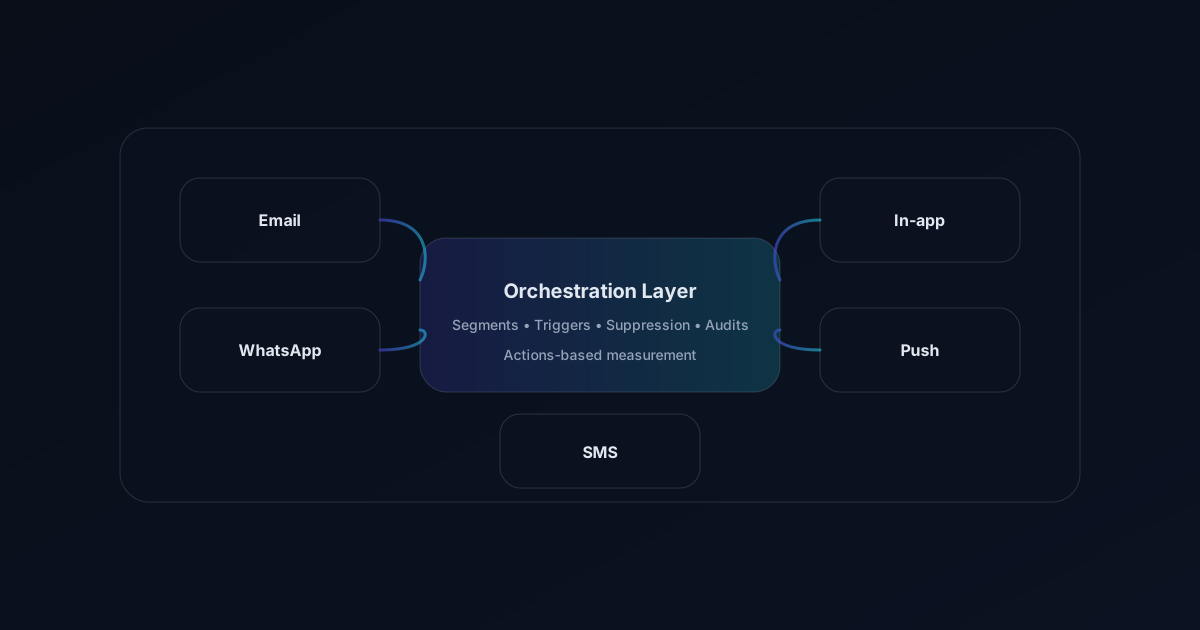
Designing and shipping a unified communication platform across email, WhatsApp, in-app, push, and SMS so lifecycle messaging became more relevant, measurable, and governable.
Mapped the user lifecycle from trial through retention to find where communication was creating noise or unclear ownership.
Defined a shared trigger, segmentation, and channel-choice model so journeys could be reviewed as one product capability.
Shifted success conversations from opens and clicks toward activation, renewal, return behavior, and meaningful user actions.
Created clearer governance for campaign ownership, escalation, review, and channel overlap.
Product showcase
Decisions made visible.
These diagrams explain the approach, with confidential implementation details omitted.
System artifact
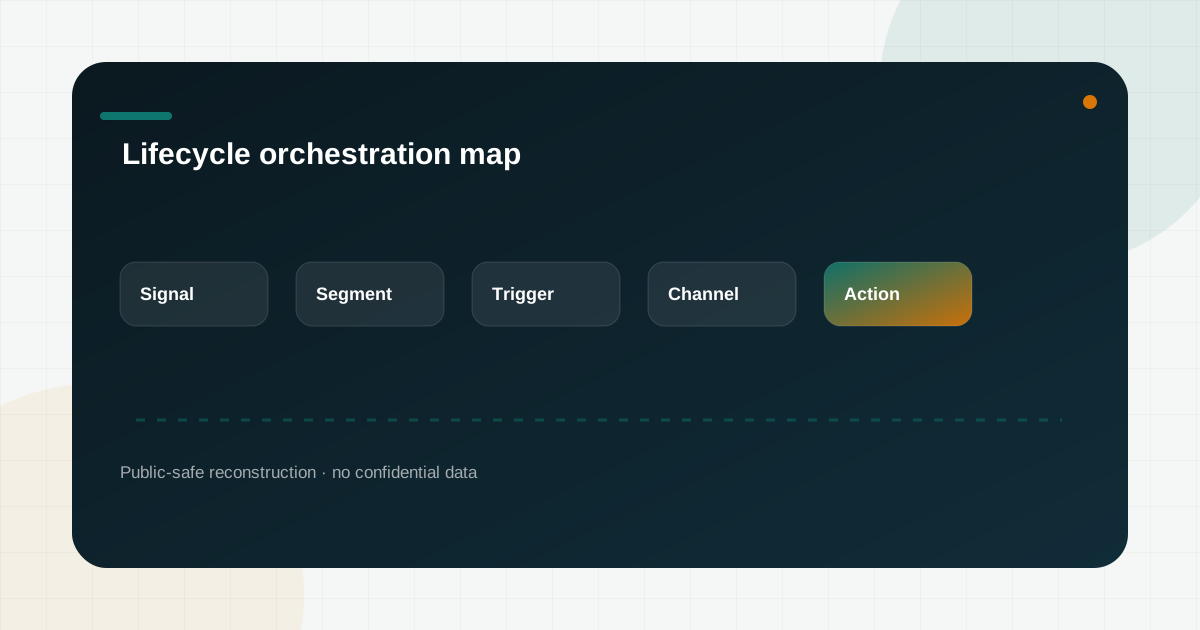
Lifecycle communication operating map
A public-safe visual summary of channels, triggers, governance, and measurement loops across the communication system.
Governance artifact
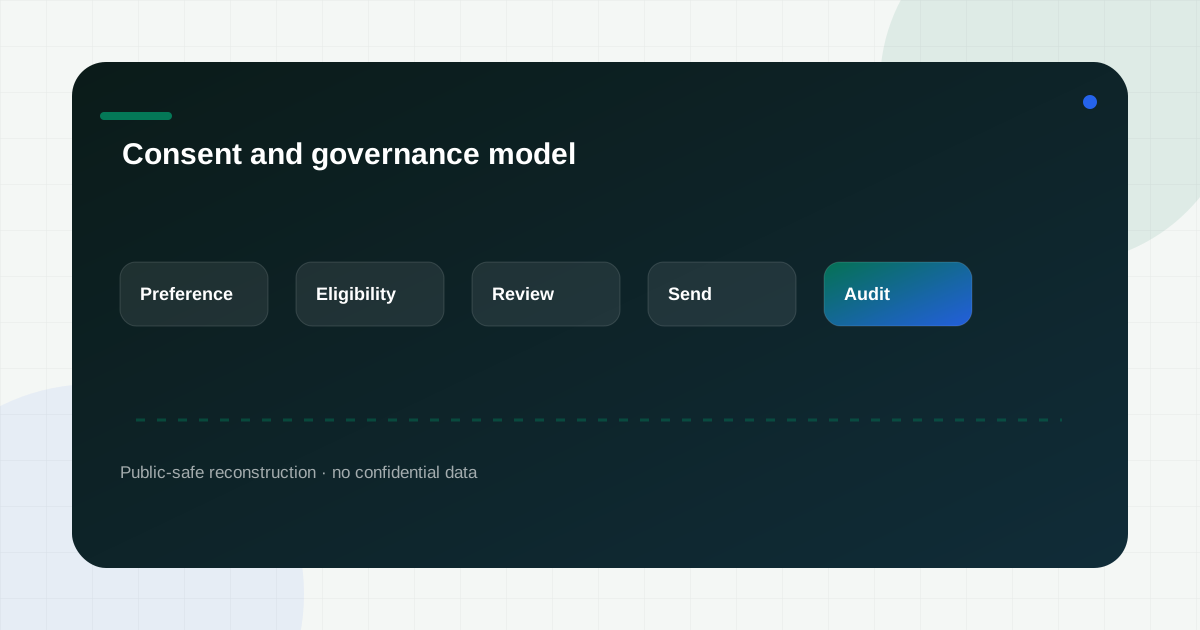
Consent and governance matrix
A sanitized reconstruction showing how consent, eligibility, frequency, and review gates govern channel selection.
Measurement artifact
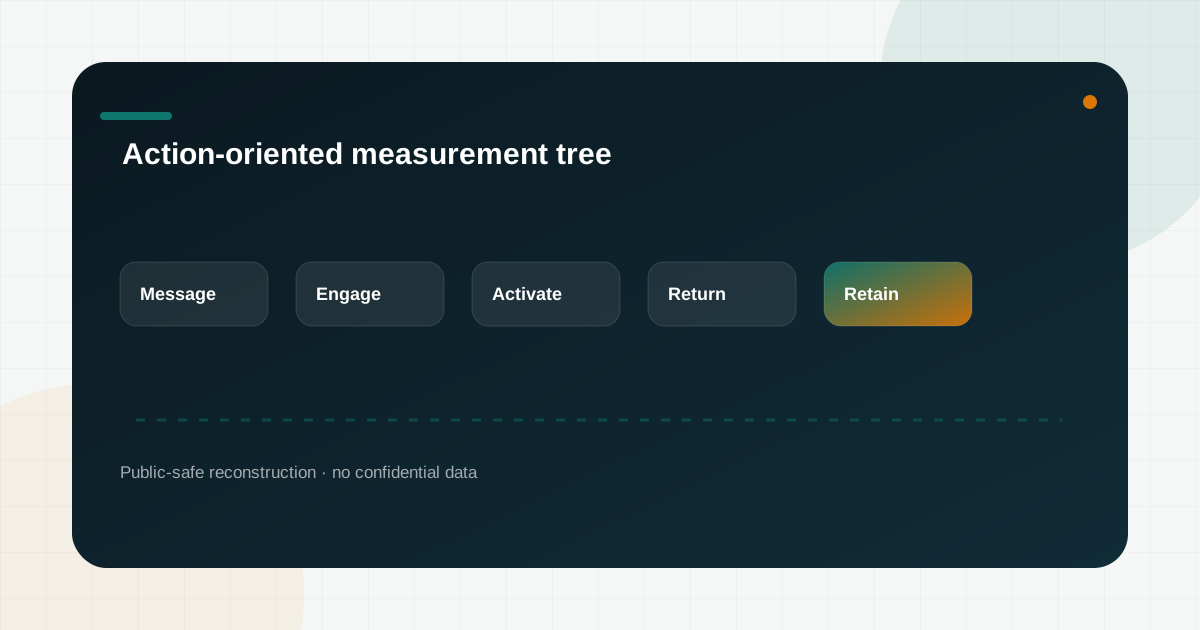
Action-oriented measurement tree
A public-safe model connecting delivery diagnostics to activation, return behavior, retention, and consent guardrails.
Outcomes
Unified lifecycle communication logic across channels
Reduced duplicate or low-context messaging
Shifted measurement from opens and clicks toward user actions
Created clearer ownership and governance for campaigns
Success signals
KPIs
TL;DR
Messaging had become fragmented across channels and teams. Users received communication, but the system behind it was inconsistent: segmentation drifted, trigger logic was uneven, and performance was often discussed in terms of sends and clicks rather than meaningful user action.
I led the product strategy and delivery of a unified communication platform that brought channels, triggers, measurement, and governance into one operating model.
The goal was straightforward: make lifecycle communication more relevant for users and more manageable for the business.
1) Why this mattered
In investing products, communication is not an accessory. Alerts, nudges, reminders, and updates often shape whether a user takes action, understands market context, or returns to the product at the right moment.
When those messages are fragmented, the cost shows up quickly:
- duplicate notifications across channels
- unclear ownership of journeys and trigger rules
- weak visibility into which communications actually drive user action
- difficulty balancing growth goals with consent, compliance, and fatigue
The product problem was not only messaging volume. It was lack of a shared system.
2) The core product problem
Before the platform work, lifecycle communication behaved more like a collection of separate campaigns than a coordinated product capability.
That created several risks:
Inconsistent relevance
Users could receive communication that was individually reasonable but collectively noisy or poorly timed.
Weak measurement
Teams could describe opens and clicks, but that did not always explain whether a message helped a user activate, return, or complete a meaningful action.
Governance gaps
Without clearer rules for ownership, suppression, escalation, and channel choice, the system depended too much on manual coordination.
3) Product objective
The objective was to build a lifecycle communication capability that could:
- support multiple channels from a shared logic model
- define trigger behavior and segment handling more consistently
- improve measurement from communication activity to product outcomes
- give the business clearer operational control over how journeys were designed and reviewed
This was both a user-experience project and an operating-model project.
4) Discovery and framing
The fastest way to frame the opportunity was by mapping the lifecycle moments that mattered most.
I focused on questions such as:
- Which user journeys depend on timely communication?
- Where do current messages duplicate effort or create confusion?
- Which channels should be primary for which type of event?
- What actions actually signal value after a message is sent?
- Where are consent, suppression, and fatigue decisions too implicit?
This work made it easier to move from “campaign execution” to “communication system design.”
5) The solution
Shared lifecycle logic
The platform established a clearer trigger and segmentation model across onboarding, activation, retention, renewal, and re-engagement journeys. Instead of designing each communication in isolation, teams could work from a more coherent lifecycle framework.
Channel orchestration
The goal was not to use every channel at once. It was to decide when each channel made sense, how messages should sequence, and how overlap should be limited.
Action-oriented measurement
A key product shift was moving discussion away from surface communication metrics alone. The platform encouraged teams to track what happened after the message: activation, configuration, usage, return behavior, or another meaningful user action.
Governance and reviewability
Ownership, escalation paths, and review rhythms were made clearer so the communication layer could scale without becoming chaotic.
6) Delivery approach
This work required strong coordination because it touched several domains at once:
- product strategy and prioritization
- journey and experience design
- channel execution and operations
- analytics and instrumentation
- compliance and policy alignment
The delivery approach was therefore incremental. Priority journeys were defined first, the shared rules and dashboards were clarified, and rollout happened in a way that let the team learn without losing operational control.
7) Outcome
The most important outcome was system-level clarity.
After the work, lifecycle communication could be discussed and improved as a product capability rather than a disconnected set of campaigns. Teams had a clearer model for trigger design, channel choice, performance review, and governance.
Public-safe impact signals from the work:
- clearer lifecycle ownership across communication journeys
- better alignment between message design and user action goals
- less duplication and less ambiguity in how channels were used together
- stronger foundation for future experimentation and personalization
8) Why this case study matters
Many companies think they need better copy or more campaigns. Often they actually need a better operating system for communication.
This project reinforced that:
- relevance beats volume
- user action is a better north star than open rate alone
- channel strategy should be designed, not improvised
- governance is part of product quality, not separate from it
For AI workflow product leadership, the transferable lesson is especially relevant: repeated cross-team coordination, fragmented triggers, and unclear review logic are signals that the product opportunity sits in the workflow system. AI can assist parts of that system, but it still needs explicit context, ownership, controls, and outcome measurement.
9) Next extensions
If taking the system further, the next highest-value areas would be:
- deeper personalization based on user behavior and preference state
- stronger fatigue management and suppression rules
- more explicit feedback loops between messaging performance and roadmap decisions
- improved creator workflows for teams designing and reviewing lifecycle journeys
Related thinking
Methods used
Have a similar product problem?