

Case study
Confidential details omittedKalkine: Lead Magnet & Recommendations Experience Optimization
The lead-magnet journey created interest but did not make the value exchange, trust cues, and first recommendation access clear enough for high-quality conversion.
Context
Kalkine
Role
Product Manager (Conversion + UX)
Engagement type
Lifecycle and growth systems
Audience
Growth, product, CRM, and analytics teams
The approach at a glance
Kalkine: Lead Magnet & Recommendations Experience Optimization
Executive summary
Improving trial-to-lead conversion and subscriber engagement by redesigning the lead magnet journey, strengthening trust cues, and reducing friction to first recommendation value.
Treated the flow as a trust transaction, not only an acquisition screen.
Clarified what users receive, why it matters, and what happens after submission.
Reduced the path length for subscribers who needed faster access to useful recommendation content.
Created a repeatable experiment pattern for improving conversion quality without weakening trust.
Product showcase
Decisions made visible.
These diagrams explain the approach, with confidential implementation details omitted.
Funnel artifact
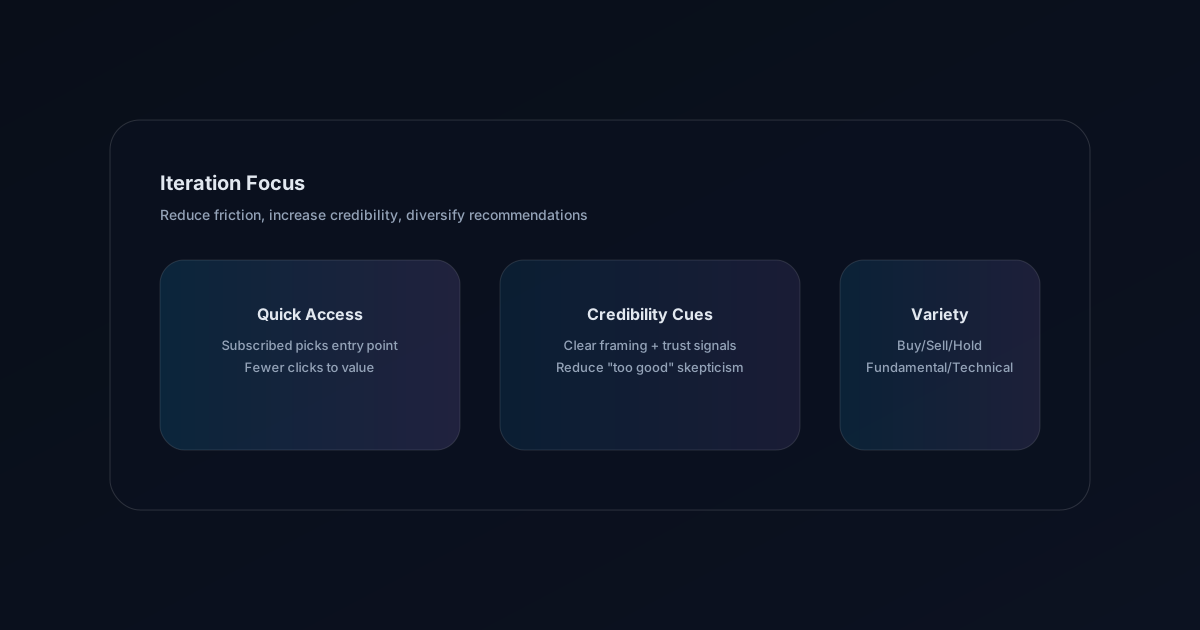
Trust-first conversion journey
A public-safe visual artifact for the lead magnet journey, subscriber access path, and measurement loop.
Outcomes
Clarified the value exchange for new users
Reduced friction between lead capture and first recommendation view
Improved subscriber access to relevant recommendation surfaces
Created a stronger experimentation pattern for conversion surfaces
Success signals
KPIs
TL;DR
The original lead-magnet experience created interest, but it did not consistently deliver the strongest possible first impression. The product needed to do a better job of explaining value, reducing hesitation, and helping both prospects and subscribers reach useful recommendation content faster.
I led an iteration cycle that tightened the journey end to end: clearer positioning, stronger trust cues, more useful recommendation diversity, and a shorter path to the moment where users could actually see value.
1) Why this mattered
Lead magnets in fintech are not just acquisition devices. They are trust surfaces.
Users decide very quickly whether a recommendation experience feels credible, over-marketed, or hard to understand. That means the design problem is broader than conversion copy. It includes access, framing, expectation-setting, and the first interaction after sign-up.
The product challenge here was to improve both conversion quality and early engagement quality.
2) What was not working well enough
Several issues were creating unnecessary friction.
Value was visible, but not obvious enough
The lead-magnet surface hinted at usefulness, but it did not always make the value proposition instantly legible.
Subscriber access had too much effort in the path
Returning or subscribed users still faced extra navigation before getting to the recommendation content they cared about.
Recommendation variety affected credibility
If the surface looked too narrow or too predictable, users could question how robust the recommendation logic really was.
3) Product objective
The product objective was to improve the journey across three connected moments:
- first exposure to the lead-magnet value proposition
- submission and transition into the experience
- faster access to useful recommendation content after entry
The aim was not to make the flow louder. It was to make it easier to trust and easier to use.
4) Discovery inputs
The fastest product insight came from treating this as a funnel and confidence problem rather than a single-screen redesign.
Inputs included:
- prototype feedback and friction points from the early experience
- review of where users hesitated between curiosity and action
- evaluation of how quickly users reached recommendation content after conversion
- comparison of messaging, trust cues, and recommendation framing across variants
This made it easier to prioritize changes that improved the quality of the first recommendation experience, not just the submit button.
5) The solution
Clarify the value proposition
The lead-magnet experience was rewritten and restructured so users could understand what they were getting, why it was useful, and why the product felt credible.
Reduce path length for subscribed users
The product introduced clearer, faster access to recommendation content for users who had already completed the acquisition step. This reduced unnecessary looping through acquisition surfaces.
Improve recommendation framing and variety
The experience presented recommendation content with better scanability and a stronger sense of breadth. That improved credibility by making the surface feel less like a single pitch and more like a considered product capability.
Strengthen trust cues
Users needed more than outcome language. They also needed framing that reduced skepticism and made the recommendation experience feel deliberate rather than overly promotional.
6) Delivery approach
This work moved in iterative loops because conversion surfaces change behavior quickly, and the cost of overbuilding before learning is high.
The delivery pattern was:
- identify the sharpest points of friction
- tighten copy, hierarchy, and access paths
- ship improved variants in manageable scope
- observe what improved clarity and downstream engagement
That let the team improve both the lead surface and the recommendation access experience without treating them as separate products.
7) Outcome
The strongest outcome was a higher-quality path from curiosity to value.
Users could understand the proposition more quickly, and subscribers could reach useful content with less effort. Internally, the product team also gained a better framework for how to improve conversion-oriented surfaces without weakening trust.
Public-safe impact signals from the work:
- clearer explanation of what the user receives and why it matters
- less friction between conversion and recommendation access
- improved alignment between acquisition surfaces and subscriber experience
- stronger foundation for future experimentation on conversion quality
8) What this work reinforced
A few product lessons were consistent throughout:
- in fintech, trust has to be designed into the conversion surface
- reducing time-to-first-value matters as much as lead capture
- subscriber journeys should not feel like recycled acquisition flows
- recommendation variety can strengthen credibility when it is framed clearly
9) What I would push next
The next improvements I would explore are:
- explainability cues for why a recommendation is being surfaced
- tighter experimentation around copy, defaults, and recommendation ordering
- richer subscriber entry points for repeat-use behavior
- clearer measurement of quality after conversion, not just form completion
Related thinking
Methods used
Have a similar product problem?