

Fintech product work punishes vague thinking.
A normal product team can often ship a rough first version, learn in production, and recover later. In fintech, the same shortcut can create support spikes, compliance exposure, broken trust, or real financial harm for users. That means the PM job is not only to move fast. It is to create a system where speed, safety, and decision quality can coexist.
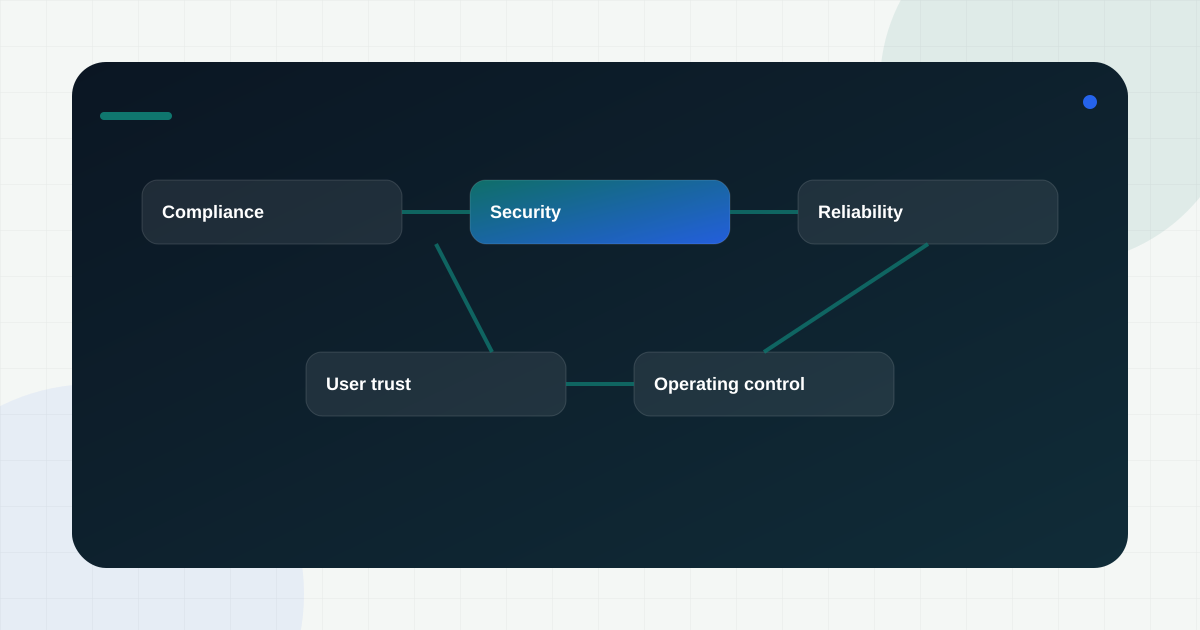
The practical framing I use is simple: every meaningful fintech initiative has to hold together across compliance, security, and innovation. If one side is weak, delivery slows down later or trust collapses after launch.
The operating mistake most teams make
The common failure mode is treating compliance and security as specialist review steps that happen after product decisions are mostly locked. By then the team has already committed to a flow, an event model, or a launch date. Review becomes rework, and rework gets mislabeled as “process overhead.”
A better approach is to convert those concerns into product inputs early:
- compliance becomes a set of release constraints and approval checkpoints
- security becomes a set of user-risk scenarios and system guardrails
- innovation becomes a set of reversible bets, not heroic one-shot launches
That shift changes the whole tempo of delivery.
1) Compliance is a product design constraint
Compliance is easiest to manage when it is visible in the product spec, not buried in a late checklist.
For example, if a feature touches communication consent, pricing claims, suitability, or portfolio visibility, those requirements should appear in the PRD next to the user flow. They belong with the work because they shape the experience.
A simple pattern works well:
- define the policy or regional rule in plain language
- translate it into a user-facing requirement
- attach the evidence or owner needed for launch
- add it to acceptance criteria so QA can verify it
This keeps teams out of the trap where “legal approved it” is treated as enough. Approval is not implementation quality.
2) Security should be framed as user-risk prevention
Security discussions go nowhere when they stay abstract. PMs get more leverage by grounding them in concrete user failure modes.
Ask questions like:
- How could a user lose access at the worst possible moment?
- Where could a misleading state create a bad financial decision?
- What happens if a downstream dependency fails during a sensitive action?
- Which event or notification could be sent to the wrong audience?
Those questions turn security into product work. They help Engineering, QA, and stakeholders reason about recovery flows, permissions, observability, and incident readiness in terms of user impact rather than only technical hygiene.
In trust-sensitive products, strong recovery design matters almost as much as prevention. Users judge the system by how it behaves when something goes wrong.
3) Innovation has to be reversible
Fintech teams still need to innovate. The mistake is assuming innovation means a broad launch with weak guardrails.
The healthier pattern is reversible progress:
- feature flags instead of irreversible rollouts
- limited cohorts before broad exposure
- explicit kill criteria before launch
- instrumentation that measures actions and trust signals, not only opens or clicks
That lets teams test ambitious product ideas without pretending uncertainty does not exist.
A PM who cannot explain the rollback path usually does not yet have a launch plan. They have enthusiasm.
4) Turn review into a reusable operating model
The best fintech teams do not rely on heroics every sprint. They build a repeatable operating model.
A lightweight version looks like this:
- Discovery identifies user value, policy constraints, and failure modes together.
- The PRD records launch scope, owners, risk notes, and measurable success criteria.
- Engineering and QA review the edge cases that matter most before implementation hardens.
- Launch readiness checks evidence, dashboards, support preparation, and rollback options.
- Post-launch review looks at user actions, drop-offs, trust signals, and incident learnings.
The value is not ceremony. The value is fewer expensive surprises.
5) Metrics should measure trust, not only throughput
Fintech dashboards often over-index on mechanical delivery metrics: open rates, click-throughs, or feature usage in isolation. Those are useful, but they are not enough.
A stronger metric set includes:
- activation tied to a meaningful user action
- drop-offs in sensitive flows such as consent, verification, or payment setup
- support contact volume after launch
- recovery success for high-risk errors
- repeat usage of trust-heavy features such as watchlists, alerts, or performance views
These signals tell you whether the experience feels dependable, not just whether it was seen.
A sprint-ready checklist
Use this list when a fintech initiative is moving from idea to delivery:
- Write compliance and security expectations into the PRD, not a side document.
- Define the worst plausible user outcome and the guardrails against it.
- Decide what will be feature-flagged, staged, or cohort-limited.
- Add launch metrics that capture trust and action quality.
- Confirm support, QA, and rollback readiness before broad release.
- Review what evidence is required for sign-off and who owns it.
Final takeaway
Strong fintech PMs do not choose between compliance, security, and innovation. They design workflows where each one reinforces the others.
When those forces are aligned, delivery actually gets faster. Teams spend less time undoing preventable mistakes, and users experience a product that feels safe, clear, and worth returning to.
If your team is shipping into a regulated or trust-sensitive environment, this is the bar: build for learning, but build with consequences in mind.